California Supreme Court determines advances of forensic science sufficient to vacate conviction

Its all about 2 bitemark opinions from a murder trial.

In an unanimous 7-0 decision, the court’s holdings vacates Bill Richards murder conviction from 1997 and makes his imprisonment since 1993 subject to release from prison and opens up future exoneration proceedings. Richards had a successful 2009 exoneration overturned on appeal by San Bernardino County’s DA Michael Ramos and the state’s Attorney General Kamala Harris who is now running for the US Senate.

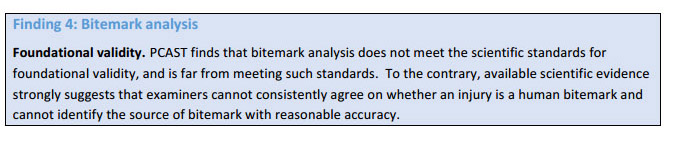
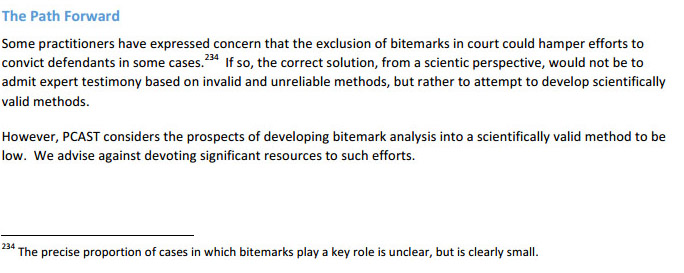
The telling points made  by this court in Richards’ favor were enabled by its using the 2014 new California “junk science” Penal Code statute 1473 created directly because Richards’ appeals. His 2012 attempt to prove evidence of his guilt from a pair of bitemark experts was “false” failed in what this court calls Richards I.

Background from Richards’ 1997 4th trial for murder.

Previous to 1997, there were 2 hung juries and a court had recused itself.

The State’s forensic dentist Dr. Skip Sperber had determined at 4th trial that Richards’ teeth “were consistent” with a skin lesion on his murdered wife’s right hand.  In an added comment, Sperber said Richards’ teeth were seen in the human dentition “2 out of 100” people. Richards’ defense dentist agreed in part by saying the lesion was definitely a human bitemark.

bitephoto2

Evidence considered a human bitemark in 1997.

In 2009 both dentists recanted in affidavits and later court testimony. They credited the use of “new” advances in digital imaging allowed them to see a single autopsy photo of the victim’s hand without its original off-angle camera distortion. That was made possible by this forensic dentistry digital imaging manual.

Back to today’s “High Court” opinion.

“The plain meaning of the amendment to section 1473 makes clear that an expert opinion given at trial can later be deemed ―false evidence‖ under two circumstances: (1) if the expert repudiates his or own opinion given at trial; or (2) if the opinion given at trial is undermined by subsequent ―scientific research or technological advances.‖ (§ 1473, subd. (e)(1).) We conclude that, under this amendment to section 1473, petitioner has met his burden to show that Dr. Sperber‘s trial testimony constituted false evidence under either circumstance.”

Soon we will hear what the San Bernardino DA has to say about this. According to a news report in 2012, San Bernardino has never had an exoneration on the books under Ramos’ tenure.  The same article has the DA office offering considerable resistance to the term “exoneration.” DAs in this situation have 60 days to ponder whether to re-charge after a vacated conviction. This potentially would be Richards’ 5th trial for murder.

Here is the broader context of Richards’ now improved chances for  freedom.  DA Ramos has also gone on the record saying he considers frivolous appeals are “clogging up” California’s Criminal Justice system.

The future trial?

Any new filing of murder charges by the DA against Richards will bring a litany of CSI high value evidence against Richard being guilty. In fact it forms a road to his actual innocence.

A jury would have to consider some of the following:

  1. DNA from an unknown make have been recovered from the murder weapon.
  2. DNA from an unknown male was found under the victim’s fingernails.
  3. The Supreme Court court noted that the bite mark evidence had been “clearly repudiated” and that “new technological advances undermined” the bite mark evidence presented at trial.
  4. The crime scene evidence collection was either faulty or not complete which resulted in significant evidence being abandoned or lost at the outset of the San Bernardino Sheriff’s investigation.
  5. The Supreme Court also said that the defense had presented strong evidence opposing Richard’s guilt at his 4th trial where he was convicted EXCEPT for the bitemark evidence.

The total court’s opinion of In re William Richards is here.  Its 45 pages.

Richards’ litigation team is the California Innocence Project at California Western School of Law. This is its Twitter feed.

 
@CA_Innocence


Posted in Uncategorized | Tagged , , , , , , | Leave a comment

Washington DC crime lab continues to coverup its law enforcement bungles

Forensics In Wash DC: Former crime lab managers punished for telling the unpopular truth to their bosses.

csidds's avatarFORENSICS and LAW in FOCUS @ CSIDDS | News and Trends

Backstory before the story about guns walking away from the DC crime lab.

After a sweetheart period with its “independence” from LEO management via its multi-million dollar facility up grade and hiring forensic scientist Max Houck to run it, the D.C. DFS bloom has gone off the rose.

Dr. Houck got himself resigned/fired from DFS by a consortium of LEO, DA and mayoral accusations of his Forensic Biology Unit’s mixture DNA statistical choices regardless of similar DNA protocol disagreements existing within the general crime lab industry.

Some in the national DNA hierarchy called it a “sentinel event” in the history of crime lab decision making. With scant exaggeration,  it struck to the heart of what some of us considered a significant foothold for “reform in forensic science.” One called it a “setback for forensic science.”

DNA gurus Inman, Rudin and Siegel demanded answers here.   The DNA trio issued a…

View original post 948 more words

Posted in Uncategorized | Leave a comment

Washington DC crime lab continues to coverup its law enforcement bungles


Backstory before the story about guns walking away from the DC crime lab.

After a sweetheart period with its “independence” from LEO management via its multi-million dollar facility up grade and hiring forensic scientist Max Houck to run it, the D.C. DFS bloom has gone off the rose.

Dr. Houck got himself resigned/fired from DFS by a consortium of LEO, DA and mayoral accusations of his Forensic Biology Unit’s mixture DNA statistical choices regardless of similar DNA protocol disagreements existing within the general crime lab industry.

Some in the national DNA hierarchy called it a “sentinel event” in the history of crime lab decision making. With scant exaggeration,  it struck to the heart of what some of us considered a significant foothold for “reform in forensic science.” One called it a “setback for forensic science.”

DNA gurus Inman, Rudin and Siegel demanded answers here.   The DNA trio issued a statement ….

“However, we assert that if all U.S. forensic DNA laboratories were held to the same standard to which the D.C. DFS lab was held, few would be left standing.

A D.C. DA lead review of 182 cases after Houck’s firing seems to not have made the news since Houck’s 2015 firing.

His replacement after an interim director is  now the fully appointed director, Jenifer Smith who spearheaded…………

“As a DFS consultant, Smith provided her expertise in assessing the findings of the Independent Audit of the Forensic Biology Unit, and provided her recommendation for trainings on DNA mixture interpretation.”

In other words, after participating (after the fact but surely profiting from it) in the contested by a few (see below) audit by ANSI-ANAB’s (which itself has no lack of detractors) cadre of ex-crime lab directors, she eventually got Houck’s job.

The DFS advisory board had another member, the same Jay Seigel noted above, who put out a telling letter to the California Asso of Criminalists  (pg 11) in 2015 about his take on Houck’s ouster the consortium. Bold is added as emphasis.

“Recent events that culminated in the hasty and in my view, unwarranted dismissal of the administration of the DFS has given me great pause and concern. The only scientific issue of merit in this process was the protocols used in the interpretation of the level of significance of contributors to certain DNA mixtures. It is well known in the forensic science community that there are no standards for the statistical interpretation of such mixtures. The DNA unit of the DC Forensic Science Laboratory was using methods that represent a consensus among many forensic science DNA units nationwide. The Panel convened by the DC US Attorney’s Office had a different opinion about the protocols that should be used by the laboratory. On the advice of the Scientific Advisory Board, the Laboratory changed some of its protocols and SOPs in the area of DNA mixtures. The laboratory made several requests of the USAO to furnish it with the protocols that are used by the Panel, but was unsuccessful. At its meeting of April 24, 2015, the Scientific Advisory Board began to prepare a letter to the USAO to furnish this and other information so that the Board could examine the merits of the Panel report. During the latter stages of that same meeting, the report of the independent 3rd party, who was commissioned by your office to evaluate the DNA unit, issued its report to you. The Board received the report late in the afternoon of its meeting on April 24. The Board had no chance to evaluate this report during that meeting or in the few days after. Just a few days later, without consultation with the Board, you proceeded to fire the senior administration of the Laboratory. The Board had no chance to review the issues raised in the two reports and to perform its statutory duties of advising the Laboratory, your office and the City Council. The District of Columbia has an extensive and well-deserved reputation for political interference in a wide variety of its activities and processes. I hoped that this would not be the case with the DFS when I joined the Board. My hopes were misplaced. The actions you and I believe the USAO have taken in this matter were clearly not based on scientific considerations since the Scientific Advisory Board had no chance to provide advice BEFORE you took such drastic actions. I cannot continue to serve as a member of the Science Advisory Board and I hereby resign, effective immediately. Sincerely, Jay A. Siegel PhD”

Others who formed the admin of DFS during Houck’s tenure have also been lopped off the tree.

Its general counsel, Christine Funk  got terminated. Her history as criminal defense counsel surely opposed the new director’s 23 years of FBI employment. The chief scientist and the DNA Unit manager were also fired.

“Funk’s boss (Max Houck) says her experience makes her invaluable to DFS . . . She understands the law, she understands the labs, and she’s about as knowledgeable about science as any attorney I’ve met,” Director Max M. Houck said. “As an independent agency, she provides us with the insights and feedback we need to stay objective. She’s our keystone.”  From a 2013  DFS post before the coup occurred.

In their salad days in early 2015, Funk and Houck were international speakers in the UK on the subject of independent managed crime science facilities and, among other subjects, certain “reform” procedures considered progressive. This four day meeting’s theme was “A Paradigm Shift for Forensic Science,” It did not include having ex-officio firings occur as described supra.

Guns on the Run?

The latest victim to this resurgence of  political, police and prosecutorial control just filed a wrongful termination suit revealed in his claim a pattern of fire-arm mismanagement tangentally akin to the “Fast and Furious” BATF debacle  from 2011 (which is still simmering). The press brought us from that debacle the F&F term “gun walking” used by law enforcement.

Apparently guns have been “walking” out of the ballistics and firearm unit of the DC lab for years. The guy who made the finding is the one filing the lawsuit. He was their gun manager.

Of course a real question is “who is stealing the weapons out of the evidence room and selling them on the streets of Washington D.C.?

Here’s a snippet from the lawsuit:

“Jason Kolowski claims the department fired him one week after he disclosed an “anomaly” in the its database that showed weapons with the same serial number entered twice for unrelated cases.”

Read The tale of lost guns in the D.C. Evidence locker. 


Posted in AAFS, US Crime labs | Tagged , , | 1 Comment

Looking at law enforcement’s “excited delirium syndrome” deaths from a medical perspective.

\

Here is another forensic conundrum.

The AMA doesn’t recognize it, neither does the World Health Organization, nor a host of other “learned” medical groups.

Taser Inc does. So do police unions representing LEOs in wrongful death litigation.

Welcome to the “excited delirium syndrome” (ExDS) which to some is documented as occurring when only police are present.

Others call it, “prone restraint asphyxia” or similar,  but that’s usually the families of the deceased inmates or police detainees who died in the presence of law enforcement in a manner arguably seen nowhere else.

The veteran blogger Texan Grits for Breakfast lays out in depth the history of police custody deaths being considered a syndrome by public legal speakers, some docs and litigation sensitive for-profit corps in the LE equipment business.

Grits states that even if the two word term is just a trumped up excuse, the numbers of in-custody deaths can be seen as possibly mobilizing LE agencies to reconsider  how they interact with non-compliant, drug OD’d and/or dangerous members of the citizenry. Here is some of that. 

Amnesty International has gone public debunking ExDS’ usage by some medical examiners. 

Here is a trio of young ER docs on the FBI Bulletin website talking about it being a serious health issue.

The National Institute of Health did 2011 a review narrating about ExDS, although not recognized in the medical literature lexicons, warning  “that a lack of recognition of the condition in the context of law enforcement activities does not negate the significance of the behavioral and physical signs referred to as EXD.” The article goes but is internally contradictory about where the deaths actually occur. The available data seems incomplete at best. It may mean that some patients ( from the ER POV ) are already dead when they get to the ER and there were no docs around to witness the onset, etc. of death of this maybe “clinical spectrum of one disease.” I think THAT’s wishful thinking. Sometimes in medical data analysis, incomplete information can lead to suppositions rather than conclusions. On the research front…

I can’t imagine a comparative clinical study of supposed ExDS  collecting data of asphyxial deaths in suicides, drug overdoses and non police attended death scenes being studied anytime soon. My perspective has the prone restraint death assertions being separated from the clinical diagnostics information brought forth by the medical emergency folks. The docs only see the aftermath of those arriving non-responsive from custody.

Here is more from the ER environment. The popular linking of symptoms into a “triad” is in this one. Hmmm. So does SBS. Coincidence? Not really as linkages of symptoms is a rudimentary tool of medical investigation.

A final reference is from a LEO publication describing ExDS as “rare.” 

I doubt that any of this is reassuring to families of the deceased who started in the jail lock-up and ended up dead.


Posted in police custody deaths | Tagged , | 2 Comments

The Judiciary’s public shaming of trial prosecutors as a means to achieve justice?

This is a 48 page legal paper, but the author puts into the clear about what’s going on between federal appeals courts and the prosecutors who end up on their hit list. With no empowerment to reverse convicts, the fed justices resort to very public proclamations of prosecutorial shenanigans or worse.

Full article

Thanks to the Wrongful Conviction Blog

Posted in Perjury by Prosecutors, prosecutorial misconduct | Tagged , | Leave a comment

The Mississippi Sting operation that uncovered Michael West’s bitemark bunk

One of the extraordinary defense presentations at the recent EL Howard hearing in Columbus MS was given by the Honorable Chris Plourd (pictured above), the presiding Judge of Imperial County, CA Superior Court.

Judge Plourd rose to the bench in 2012 after a notable career as a criminal defense attorney and an early (in the 1990s) forensic DNA expert. He has a remarkable history of being involved in US national workings groups on science and forensics.

He was chief defense counsel for Ray Krone in the 1990s when Mr. Krone was twice convicted of the murder of Kim Acona in AZ. His guilt was also sealed by another infallible bitemark expert, Dr. Raymond Rawson, an ex-state Senator from Nevada. With Plourd and Krone’s family members continuing help, Krone’s DNA exoneration occurred in 2002.

Judge Plourd’s involvement in Howard is based on Plourd’s ad-hoc ( e.g. for a specific purpose) evaluation of  bitemark experts which included Dr. Michael West, the state’s star witness in Howard’s two death penalty convictions. This evaluation and West’s performance was used as character evidence unfavorable to Dr. West in these current Howard proceedings. Special Attorney General Jason Davis objected to admitting the testimony, saying the test” was subterfuge” and “a sting.”  He was overruled by Judge Howard (no relation to the defendant).

In Plourd’s direct testimony, he describes the exam as “an external blind proficiency study” he planned to extend to other members of West’s bitemark group in a neutral setting in order to test their reliability. Plourd had produced an exact simulation of how self-employed forensic experts are commonly offered cases by members of the public.

Dr. West, not knowing (i.e. “blinded) the evidence sent him was from a person masquerading as a party to a bitemark case, readily accepted to review the case treated it as an actual case.  West accepted his $750 fee and produced a 20 minute video of his brand of bitemark analysis.

Full story with all the forensic science background to the”sting.” 


Posted in AAFS, ABFO, Bitemarks, costs of wrongful convictions, Crime lab scandal, Dr. Michael West, exoneration, Ray Krone bitemark case, wrongful convictions | Tagged , , , , , , | Leave a comment

Advances of science affects some convictions – so far bitemarks aren’t included

The resounding inconsistencies in how US courts “handle” forensic expertise is brain-numbing. The Mississippi Supreme Court and the state attorney General Jim Hood’s go to chief appellate guy, Jason Davis (pictured above), are still investing in the now bitemark rejecting Michael West (pictured below) to preserve EL Howard’s death penalty conviction.  This makes no sense.

west


Here’s what’s happening in TX regarding fingerprint technology getting a man out of prison after 19 years.

“Advances in science and technology are helping to make criminal prosecutions more accurate,” said Reagan Wynn, who served as local counsel for Nolley.  “Mr. Nolley’s case affirms the Texas legislature’s decision to recognize that these same advances can be meaningful in exposing injustice where that advanced technology wasn’t previously available, by giving the wrongly convicted a way to get back into court and present that new evidence.”

Full article from the Innocence Project Blog

Posted in AAFS, Bitemarks, criminal justice, criminal justice reform, forensic science reform | Tagged , , , , , , , | Leave a comment

DNA “falsifiability” gets some airtime, CRIME LAB chaos in MA, “vigorous debate’ in SBS

The latest in scientific quandaries within forensics from the NY Legal Aid Society Newsletter.

Fool’s Gold:

Legal Aid Society DNA Unit featured in Atlantic Magazine article about the increasing use of unreliable DNA “science” in the criminal justice system

DNA analysis has always been the “golden child” in the forensic science family—whereas most forensic sciences were created by law enforcement to solve crimes, DNA science was developed by, well, scientists. But when DNA analysis left the lab and moved into the courtroom, it left a lot of the science behind.

Unlike medical DNA testing, forensic DNA relies on samples from crime scenes that are often degraded, contaminated or mixtures—“alphabet soups” of genetic information from different contributors. And while clean, single source DNA samples are easy to analyze, the science of DNA mixtures is shaky at best: “The analyst must determine how many contributors are involved, and which alleles belong to whom. If the sample is very small or degraded—the two often go hand in hand—alleles might drop out in some locations, or appear to exist where they do not. Suddenly, we are dealing not so much with an objective science as an interpretive art.”

To complicate things further, most DNA mixtures are now analyzed by “black box” software programs with secret algorithms, or as DNA expert William Thompson quips: “The data goes in, and out comes the solution, and we’re not fully informed of what happened in between.”

The Atlantic features quotes from Legal Aid Society DNA Unit attorneys Jessica Goldthwaite and Clinton Hughes—members of the Frye team that, in 2011, succeeded in challenging the admissibility of low-copy DNA evidence and the Forensic Statistical Tool (FST)—another black box software used to analyze DNA evidence at the NYC OCME. Despite both the OCME and courts denying defense access to FST’s source code, the DNA Unit has reverse-engineered the FST program with a team of computer science interns in order to show the software’s flaws.

Forensics in the News


MA-ACLU lawsuit reveals over 24,000 drug cases tested by forensic analyst Annie Dookhan resulted in convictions or “had other adverse dispositions” (ACLU)

In response to an ACLU lawsuit, Massachusetts prosecutors have disclosed (after nearly six years) lists of the 24,000 drug cases worked on by Annie Dookhan during her decade-long tenure at the Hinton State Lab. According to the ACLU, “Dookhan cases appear to account for an astounding 25 percent of all drug prosecutions that led to conviction in the seven counties that used the Hinton State Lab during Dookhan’s tenure, and one in six of such drug prosecutions in the Commonwealth over a 10-year period.”The majority of “Dookhan defendants” were not sent any official notice that evidence in their cases may have been tampered with: many defendants have remained incarcerated and others have even been deported. The Commonwealth of Massachusetts has yet to release the names ofcases affected by forensic chemist Sonja Farak, who was sentenced to 18 months prison time after she admitted to tampering with evidence and stealing drugs while working on nearly 30,000 cases.

Federal judge rejects handwriting analysis “science” and expert testimony in forgery case (New York Law Journal)

Judge Jed Rakoff of the Southern District of New York has dismissed the case of Almeciga v. Center for Investigative Reporting, granting the defendant’s motion to exclude expert testimony on handwriting analysis because of its unreliability as a “science.” In his opinion, Judge Rakoff—who was appointed by President Obama to the National Commission on Forensic Science in 2015—found that “handwriting analysis in general is unlikely to meet the admissibility requirements of Federal Rule of Evidence 702,” and that “there are no studies, to this Court’s knowledge, that have evaluated the extent to which the angle at which one writes or the curvature of one’s loops distinguish one person’s handwriting from the next. Precisely what degree of variation falls within or outside an expected range of natural variation in one’s handwriting—such that an examiner could distinguish in an objective way between variations that indicate different authorship and variations that do not—appears to be completely unknown and untested.”

Expert witness and TrueAllele software creator Dr. Mark Perlin accused by defense counsel of “cherry-picking” results in death penalty murder trial for “financial reasons” (WTAE News)
Related: Allen Wade Trial Summary (Ongoing)

Human Genome Project scientists convened “closed-door meeting” at Harvard to discuss the future of gene-editing amidst concerns about possible ethical violations that would occur with genetic engineering (NY Times)
Related: Newsweek

Scientists fight new White House initiative that would require researchers to obtain patients’ consent to use biological samples, even if identifying information is removed (STAT)

Virginia Department of Forensic Science to review 200 blood-typing cases between 1982 and 1990 after errors were found in recent wrongful conviction case (Richmond Times-Dispatch)

Ninth Circuit denies writ petition in Gimenez v. Ochoa for defendant convicted of killing his daughter based on a “Shaken Baby Syndrome” theory. The panel held that, while a petitioner can allege a constitutional violation stemming from flawed expert testimony at trial, here the evidence presented by the petitioner only indicated a “vigorous debate” in the medical community regarding the validity of the triad-only “shaken baby” diagnosis.
Related: Caselaw SummaryNinth Circuit Blog

Opinions and Commentary


From the Grits For Breakfast blog: “The [Texas] Forensic Science Commission last month found ‘professional negligence’ occurred in the ballistics analysis at the Southwest Institute of Forensic Science (SWIFS). The examiner attributed too much significance to small striations on a bullet and inappropriately chose different ammunition for test firing. SWIFS believes that ‘confirmation bias’ and ‘expectancy bias’ contributed to errors by both the examiner and the technical reviewer.”

An Editorial from My SanAntonio explains the lack of remedies for defendants who have been wrongfully convicted because of junk science in Texas by examining the case of the San Antonio 4

Fauxrensics Video Series: DNA Evidence


From the National Forensic Science Technology Center: “The Fauxrensics video series is designed to ask the question, ‘Real or Faux?’ about forensic science and investigative techniques regularly shown in popular television crime dramas. They are commonly misrepresented and these short, fun videos help educate viewers on how the science works in the real world.”

Click the picture to play the Fauxrensics episode about DNA Evidence!

Subscribe to the DNA Newsletter for the latest on forensic news. 

Check out previous editions of the DNA Newsletter!

Feedback, articles, and suggestions pertaining to the DNA Newsletter can be emailed directly to Celia Givens.
Share
Tweet
Forward
Share
Posted in AAFS, criminal justice, criminal justice reform, CSI, DNA mixtures, DNA profiling, forensic science misconduct, forensic science reform | Tagged , , , , , , | Leave a comment

Forensics: Focus on bitemark beliefs and “The Syndrome”

Dr. Death

While spending nearly a full May 5th springtime time day listening to the “Country Dentist” Dr Michael West lavish a Mississippi courtroom with his god-like powers of forensic observation aided by a blue light flashlight, I began to reflect on his statements in his previous courtroom narratives.

A short review.

Dr. West brings the power of religious faith into the court to bolster his forensic conclusions. He commonly he has done this in homicide cases involving the death penalty. West eagerly admits to testifying in 81 criminal cases as an expert. Literally using his beliefs and superior accuracy metaphors in combination with describing crime scene evidence and bitemark matching, Dr. West impresses the jury and clearly intimidates defense counsel with his incredible forensic fervor. Some of his favorite remarks show up in trial transcripts and recent testimony as……..

“In deed and without a doubt.”

“Something less than my belief in the Lord Jesus Christ.”

“He was a child-trafficker taking a 3 year-old girl from her bedroom at midnight. What else could it be?”  This is Dr. West testifying at the recent Howard hearing about MS exoneree Levon Brooks, whom he mistakenly identified, as he also did with exoneree Kennedy Brewer and others. He uses a blue flashlight and supposed two-toothed bitemark bruises.

This was also at the hearing: “I used to think bitemarks were like fingerprints.”

Did I say Mr. Brooks and his fiance were sitting in the gallery during some of these declarations?  Special Attorney General Jason Davis‘s courtroom opening statement when Dr. West took the stand accused Innocence Project’s  co-founder Peter Neufeld of calling West a murderer in the court hallway. Davis ignored mentioning Dr. West’s scurrilous ethnic epithets soon revealed by Mr. Neufeld’s immediate standing objection to the judge. West soon called Mr. Howard’s co-counsel Chris Fabricant a “sociopath” in open court. His laced a repetitive rant through out the remaining hours about “conspiracies” against forensic science and the court’s now unrealistic needs for certainty that he cannot provide.

Well, at least that last is partly true. He can’t even get photographs of the evidence he used to help convict Howard twice. All he brings is talk of “certainty.”

The court adjourned in the pm and continued the hearing until October 2016 with Dr. West still saying he only “identified the biters, not the murderers.”

In contrast to his religious certainties and notorious ad hominem antagonistic demeanor, Dr. West, his Howard gallery buddy, the non-certified forensic pathology guy Steven Hayne, and now unseated county DA Forrest Allgood have had some catastrophic criminal investigation failures. For example, working together as public servants, all missed a serial child murderer living within their midst by convicting two innocent men.

Similar evocative tactics, easily described as zealous, over-enthusiastic or fabricated, appear in cases of other court proceedings considering charges of child homicide.  Experts expound forms of testimony that elicit or border religious beliefs or at least righteous moral indignation. The 1990s come to mind…..

“The Syndrome” documentary is about the forensically questionable  “triad” of Shaken Baby assertions and gives us an analogous situation to Howard:

“The Syndrome” tells the tale of how this new category of crime appeared seemingly out of nowhere in the mid-1990s. Goldsmith found that some of the same doctors who had actively promoted the Satanic Panic of the early ’90s — accusing daycare workers of things like sacrificing animals in the classroom and raping the tots in Satanic rites — abandoned that narrative when people started doubting its plausibility.”

“In its wake, those doctors found a new horror to focus on: shaken baby. As Goldsmith puts it, “They medicalized Satan.” Attention, donations and research money flooded in.”

It is no secret that legal rules of evidence are silent regarding invoking religious beliefs into criminal testimony (a real hot potato with any jury). Neither are the these rules absolute in dismissing weakly circumstantial medical opinions which evolved within each state’s list of convictions.

Courts being unaware or in recent years ignoring broader empirical proofs or non-proofs of “expert” testimony have brought us both the “Country Dentist” and “The Syndrome.”


Posted in Bite Marks, Bitemarks, criminal justice reform, CSI, death penalty, Dr. Michael West, exoneration, forensic testimony | Tagged , , , , , , , , | Leave a comment

Ballistics runs aground in TX. Its Forensic Comm ferrets out another mini-scandal

TxForSciComm copy

This all started from a complaint filed by a solo lawyer from Texas. The complaint sounds strikingly similar to the Steve Chaney bitemark complaint that led to the shoot-down of the dentists training and teaching bitemarks at UTSA and elsewhere.

‘Professional negligence’ found in ballistics misidentification
The Forensic Science Commission last month found “professional negligence” occurred in the ballistics analysis at the Southwest Institute of Forensic Science (SWIFS). The examiner attributed too much significance to small striations on a bullet and inappropriately chose different ammunition for test firing. SWIFS believes that “confirmation bias” and “expectancy bias” contributed to errors by both the examiner and the technical reviewer.

Full 256 page TXFORSCICOMM Report

Thanks to Grits for Breakfast

Posted in criminal justice reform | Tagged , , , , , | 3 Comments