Forensic in Focus: From Witch hunts, criminal justice to some not so real forensic science.

Proof that CJ is not “always right.” TN exoneration joins growing number of innocence cases. Bitemarks included. 1 of 25 are innocent.

Prosecutorial misconduct in Japan. Japan’s Authoritarian Criminal Justice System. Tells the Facts, Names the Names 

The American Board of Forensic Odontology should be required to meet these standards. The American Academy of Forensic Sciences keeps giving them a pass. Not much longer, I hope. Some doubt exists. See further down this list.

Smithsonian lends help. Wisconsin authorities hope bone fragment from cold case will help solve 19-year-old mystery

30K federal drug convictions up for clemency review by US DOJ and Obama. Strict prereqs for eligibility.

Prosecutors Suppress Inconvenient Evidence in Death Penalty Cases | The Open File http://bit.ly/1lGqFd1  via @radleybalko

Doubts on the capabilities of the NIST/Joint Forensic Commissions to do much of anything. http://phys.org/news/2014-05-efforts-aim-shore-forensic-sciencebut.html

Witch hunts of the past seem strangely relevant today. 

Disingeuous argument supporting having a crime lab in every local jurisdiction. Considers “crime lab sharing” a risk to public safety. Total tripe. http://www.cincinnati.com/story/opinion/contributors/2014/06/01/local-crime-lab-safest-bet/9854443/

Ballistic “fingerprints” metaphor still in use. Aren’t fingerprints only unique on a 10 print card? How about latent prints?  Not so much.

Alert: Flawed Forensics – TV Series from Al Jazeera America Examining the US Justice System http://wp.me/p2224n-4Dl  via @WrongConvBlog

Presumed Innocent. College class on social science of wrongful conviction. Similar should be mandatory for the AAFS. http://sociology.la.psu.edu/news/department-in-video/presumed-innocent-mooc-for-credit-will-explore-the-social-science-of-wrongful-conviction …

Higher court said Prosecutor’s death expert was “tainted.” Asks judge to allow another appeal.

Grave find may be early false tooth. With gum disease. http://www.bbc.co.uk/news/science-environment-27587104 …

San Francisco ADA prosecuted DUI offenders while DUI offending himself… multiple times. http://www.prosecutorialaccountability.com/ca-prosecutor-flashed-badge-to-escape-duis-now-faces-2-year-suspension/ …

97% of accused plead out. Read how innocent ppl confess to crime. http://m.nydailynews.com/news/crime/judge-plea-deal-process-fixed-article-1.1806358#bmb=1 …

TX overturns 1 of every 3 child abuse cases brought by their CPS. http://gritsforbreakfast.blogspot.com/ 

Two exonerated attempting to get payment.Douglas County and crime lab insurer sued for damages. http://www.therepublic.com/view/story/0ae8385c489f4579bcda06f92d68a10d/NE–Murdock-Murders-Lawsuit … via @therepublicnews


Posted in criminal justice, fingerprints, Forensic Science, National FOrensic Science Commission, prosecutorial misconduct | Tagged , , , , | Leave a comment

Forensics in Focus – “Crime lab whistleblowers” and……. -May 22, 2014

PowerPlex 21 DNA test to review cold cases.

“Too prevent escalating costs.” New Commission to Regulate Prosecutorial Misconduct .

Forensic science? Testimony from “dog scent lineup” sent woman to prison for crime she didn’t commit. 

Asset forfeiture for college student pot dealers. “Of kingpins, pirates and privateers” .

This Man Was Sentenced To Die In Prison. Now He Wants To Fix The Law That Put Him There. 

Another face of the list of those wrongfully convicted by bitemark evidence. 

Lab whistleblower suit goes to trial, “Crime lab is never allowed to needlessly put people in danger” .

Just the beginning of taxpayer $$. Brooklyn DA to spend $1M to review convictions. $$.

Bitemark Identification Debunked? People are still teaching dentists unreliable forensics.


Posted in Bad Forensic Science, criminal justice, Exoneration costs, prosecutorial misconduct, Ray Krone bitemark case, wrongful convictions | Tagged , , , , , , | Leave a comment

Bitemark Identification Debunked? : People are still teaching dentists unreliable forensics

Sunday’s New York Times  piece on how “DNA Changed Forensic Science” was also an allegory. Much is in writing in the media about the deficiencies of bitemark identification. The 2009 landmark National Academies of Science Report on “Strengthening the Forensic Sciences was adamant about this forensic dental method’s failures to meet thresholds of validity (proofs of what they do is correct) and reliability (its adherents’ analyses and court cases reflect close agreement). This has been resonating in the press and courts ever since. 

The practitioners’ response to the NAS has been blunt. Bitemarks are still as good as DNA. The leaders of the AAFS/ABFO clearly say in court and in public that a conspiracy between the Innocence Project and bitemark opponents (one said “bitemark killers”) misled the NAS to an erroneous decision.

They and others have said the NAS investigators were not true “forensic scientists.”

The co-chairman of the NAS forensic committee, the Honorable Harry T. Edwards  profiled  these types of responses in 2011.

So, the obvious question of “whom is still performing bitemark analysis these days?” is clear. But “who, if any, are still teaching these methods” is the next logical question.

The University of Texas in San Antonio still does.

Its curricula includes “bitemark collection and analysis.” On this link you will find human-caused bitemark images taken with normal light, and “skin penetrating” special light first proposed by the famous bitemark expert, Michael West and which is still in use. Regardless of what lighting is used, these images show features that a reasonable person should opine are only “class characteristics” commonly seen in the human population. The ultimate argument in bitemark cases is what is “unique” versus “common.” The scientific literature on dental “uniqueness” was a 1980’s study that looked at 10 sets of identical  twins whose teeth marks were arbitrarily set into dental wax and clay as a substitute for skin. Non-compelling to say the least, but it is a pillar reference in the founding bitemark cases throughout the United States in the 80’s and 90’s.

And the Dade County Medical Examiners’ Office (Miami) just finished a program teaching “Process bite marks from DNA to excision.”

This is a euphemism on how to still bring dentists into court to talk about “pattern analysis” of tooth marks in skin with their brand of “probability” opinions. Don’t ask about having any data on the subject. It does not exist, but is still promised. However, a recently published $715,000 NIJ study  clearly struck out in that regard.

The bitemark faculty in both “symposia” are nearly the same. Members of the AAFS/ABFO bitemark adherents are the teachers. On the ABFO website you will find links to their Workshops on bitemarks still available at their meeting conjoined with the AAFS. Bitemark evidence is not the only subject presented at these short courses. Human identification from teeth (deceased) and cranial structures is presented along with mass disaster preparation for dentists. The NAS 2009 Report has no criticisms on these truly major contributions of dental forensics.

The multiple day courses cost from $1000 to $2000 for tuition. Travel, lodging, etc. are on those who attend. All in all, I would skip the bitemark comparison sections and focus on other subjects such as DNA collection preservation (if available) , physical anthropology (i.e. skeletons), critical thinking within the forensic sciences, rules of scientific evidence and case presentations where DNA has overturned bitemark opinions ( an optimistic hope of mine).


Posted in Bitemarks, criminal justice, Forensic Science, Forensic Science Bias, forensic science reform | Tagged , , , | 1 Comment

NY Times: “DNA Analysis Exposes an Inexact Forensic Science” + Bitemark Cases

For over 2 decades, the US press has used “inexact” in writing about certain forensic methods which are used to convict criminal defendants. Bitemark experts included. Here is the latest from the New York Times. It uses the debunked FBI’s hair matching system as its focus, but erroneous bitemark cases are included in the video material.

NY Times

By now — despite the apparent infallibility of detectives from Sherlock Holmes to Lieutenant Columbo, despite the clinical genius of wizards from Dr. Quincy to Gil Grissom — it should surprise no one that forensic science is not the model of exactitude that popular culture might have us believe. The scientific rigor of entrenched forensic disciplines has been challenged for years. Still, we live in a “C.S.I.” world, and television viewers could be forgiven for assuming that laboratory techniques used to catch bad guys are unassailable. In real life, though, the soundness of criminal analysis is being regularly tested, both in America’s labs and in its courtrooms.

See videos and the full content of this headlining article here. It includes bitemark identification “science” as an inexact aspect of forensics.

Try this for an incredible video on “How DNA Changed the World of Forensics.”

Posted in Bad Forensic Science, criminal justice, Forensic Science, forensic science reform | Tagged , , , , | 1 Comment

Comments on the White House 2014 report on “Strengthening Forensic Science”

Opinions from a forensic examiner. This material contains excerpts from the WH 2014 Forensic Science Report .  My comments (in bold) are added in certain sections. The Report excerpts are in italics. See the full report here.

===========================================

EXECUTIVE OFFICE OF THE PRESIDENT

NATIONAL SCIENCE AND TECHNOLOGY COUNCIL  (Subcommittee on Forensic Science)

WASHINGTON, D.C. 20502

Published May 2, 2014

Declaration of success

The detailed and comprehensive exploration of modern forensic science embarked on by this Subcommittee has broadened the breadth of foundational knowledge and situational awareness in the agencies, informing a meaningful framework for future analysis and coordination.

Forensic target subject matter

….covering issues relating to laboratory accreditation, certification of forensic science and medicolegal personnel, proficiency testing, and ethics.

Expectations for its use

It is the expectation of the Committee on Science that the material collated here will prove useful to policy makers in government as well as forensic scientists, laboratory managers, and other practitioners working together to strengthen the forensic sciences.

Then mentions the current National Commission on Forensic Science Commission.

The Subcommittee’s findings and work products will inform efforts to enhance future forensic science policy, research, and practice.

Abbreviations

IWG Interagency Working Group: The IWGs were each chartered with distinct objectives, and their deliberative processes included research and analysis into particular issues of impact that could be incorporated into policy proposals.

Body of the WH SoFS Report

1. ACCREDITATION OF FORENSIC SERVICE PROVIDERS (Page 3)

Challenges

Two major challenges to achieving the NAS goal of universal accreditation for forensic science providers are the diversity of disciplines—and, therefore, the diversity of tests—that fall under the general forensic science rubric, and the range of settings in which these services are provided. With regard to the former,

forensic science practitioners have self-organized into more than 20 specific disciplines focused on the analysis of evidence related to firearms, arson, fibers and hairs, impressions, questioned documents, fingerprints, tool marks, and DNA.

One of the biggest hurdles facing the forensic community is identifying providers of forensic  science services outside of the groups named above.

 The NAS report (2009) acknowledged the challenge of identifying these providers, noting that there are insufficient data available on the number and expertise of forensic examiners who are not employed in publicly funded forensic science laboratories.

 Another set of challenges to achieving the NAS report’s accreditation goals relate to the financial and other impacts that accreditation requirements would have on forensic science service providers, medical examiner/coroner offices, and other providers of forensic services……..

 Establishment of the necessary quality management systems can require significant financial and human resources; would have to be achieved in compliance with relevant government policies and regulations relating to purchasing, contracting, hiring, budget cycles, etc.; and could impact the timeliness of services provided during implementation. (i.e. creates backlogs and interruptions , reduction or cancelling of services due to unfavorable costs v benefit ratios).

Footnote 10:  There is insufficient data available to provide the exact number of forensic units.

 Another challenge to implementing the NAS’s accreditation recommendation is that there is no single Federal department, agency, or office that has clear responsibility or control over the relevant issues.

Implementation:

One approach is to work with Congress to pass legislation requiring a broad but well-defined set of forensic science service providers……

 ….craft a uniform law that mandates accreditation, with the goal of getting states to adopt this law across the Nation.

..the Department of Justice to mandate accreditation for all laboratories under its direct control and, for laboratories over which direct control is absent, mandate accreditation as a prerequisite for certain financial and other benefits…… (i.e.,grants, training enticements).

….utilize portions of some or all of the first three approaches in a well-integrated fashion and federal, state and local collaboration. (to fill gaps in this multi-state hegemony).

2. CERTIFICATION OF FORENSIC EXAMINERS (Page 9)

The 2009 NAS report concluded that “certification of forensic science professionals should be mandatory” and recommended that “certification requirements should include, at a minimum, written examinations, supervised practice, proficiency testing, continuing education, recertification procedures, adherence to a code of ethics, and effective disciplinary procedures.”

At some point, “certifying the certifiers,” as does the AAFS’s  “Forensic Science Accreditation Board, needs to be developed and implemented. This SoFS report does list a nearly comprehensive appendix of “mainstream” certifying boards of medical specialties, and boards relating to police sciences and the AAFS. The issue of “self-certifying” needs to be cured within some of these groups. (i.e. the American Board of Forensic Odontology (< 90 members). It should be note that the WH SoFS inquiry to this small group’s scientific assurances of their “science” resulted in a meager and disconnected bibliographic laundry list of case reports.)

Background

Professional certification bodies focused on the forensic sciences have existed for more than 30 years. Forensic science certification bodies typically focus on one or a few related forensic science disciplines, but there is not a certification body or process for every discipline or category of forensic testing.

 …the certification landscape for the forensic sciences is fragmented, with inconsistencies apparent even among certification programs accredited by the same entity….  See Page 9 “Table 1” in full report.

 A significant shortcoming with regard to forensic science certification today is that no fully independent accrediting body (i.e., one that exists outside the field of forensic science itself) exists to assess and, as appropriate, give its imprimatur to worthy forensic science-related specialty boards that confer certification. This supports my opinions on the subject.

Thus the current approach to certification (The AAFS’s FSAB) in the forensic science domain is lacking both in terms of the gaps that exist among some subspecialties  and in terms of the level of independent evaluation of existing processes and programs.

Current Status

….there are approximately 8,700 certified forensic science practitioners. Slightly over 5,500 of these practitioners are associated with digital evidence and photography, many of whom are associated with corporations…….. it also highlights the low number of other, more traditional forensic science practitioners who have achieved this measure of professional standing.

the SoFS deduces that of all forensic science practitioners, perhaps 16 percent to 25 percent are certified and this range drops to approximately 6 percent to 9 percent if those practitioners in digital evidence are removed from the calculations

 Challenges

A [related] challenge is that the development of certification standards and practices (including training and examinations) may not be cost effective or otherwise practical for disciplines in which relatively few practitioners exist.

And determining the number of forensic science practitioners within the broad definitional field that includes those working in public (Federal, state, and local) and private laboratories, as well as consultants and others working in the full range of scientific disciplines, has proven difficult.

While there is a need to resolve this issue, there are few resources available to help make a reliable estimate.

As a related challenge, certification bodies may be called upon to develop a “basic forensic science” certification for practitioners working in disciplines for which no certification program exists. I would make an edit to read: “no scientifically validated certification program exists.”

The time and cost demands posed by multiple certification processes may dissuade some practitioners from qualifying in all the areas in which they currently practice, and could result in a loss of expertise in certain areas.

Provisions may have to be made to accommodate longstanding practitioners who do not meet new certification requirements.

Time-in-service is no guarantee of scientific validity or reliability in any science. I view this as caving –in to practitioner pressure and abdicates forensic responsibilities of protecting the public .

Implementation

The implementation of a universal requirement for certification of forensic science practitioners is an exceedingly complex issue because of the large number of individuals performing such a broad array of duties who would be covered by such a provision. U.S. forensic science service providers and forensic units employ an estimated 35,000 to 50,000 (12)  individuals today, predominately in law enforcement agencies, with most of these individuals providing limited forensic science services and the wide array of other stakeholders, including private entities and government agencies at the local, state, and Federal level.

Footnote 12: There is insufficient data available to provide the exact number of forensic units. This is an estimate based on information obtained from various accrediting bodies, law enforcement agencies and professional organizations. Formal surveys to obtain more exact figures have been initiated, but have not been completed as of this writing.

Congressional action may be required to achieve effectively the NAS goal of universal certification across the forensic sciences. But the development of certification programs need not wait for legislation and could be encouraged by administrative actions aimed at incentivizing progress towards this goal, including provision of grant funding for the development of curricula, training, and testing.

In this Report, the interaction between forensic providers AND the case law events occurring within the criminal justice system (i.e. exoneration cases involving faulty prosecutorial forensic evidence is not considered a determinative factor for these efforts.

Costs

The total cost of achieving universal certification of forensic science service practitioners is very difficult to estimate given the large uncertainties described above, including the number of practitioners that would be captured by any such requirement, the number of certification programs that might need to be developed for disciplines that do not currently have such programs in place, and the costs of achieving compliance…….

The full Report has extensive cost estimates and projections on all of this.

3. CERTIFICATION OF MEDICOLEGAL PERSONNEL (Page 14)

See the full Report.  This area of forensic investigation has formalized very well due to the efforts of the American Board of Medicolegal Death Investigation. What is very problematic  is the lack of implementation of standards in training within the United States Coroners systems, both local and state.

4. PROFICIENCY TESTING OF FORENSIC EXAMINERS (Page 19).

The first section praises the benefits of testing personnel regarding accuracy and inter examiner agreement of evidence analysis. The gold standard is obviously the academically developed protocols of DNA analysis. This is contrasted with the next section.

Current status

No national requirement exists today demanding that forensic science service providers participate in proficiency testing, but many do to varying degrees.

5. A NATIONAL CODE OF ETHICS FOR FORENSIC SERVICE PROVIDERS (Page 24).

[The 2009 NAS] report further calls for an exploration of potential enforcement  mechanisms for addressing serious ethical violations.

One approach to achieving this goal, in synchrony with the NAS goals of requiring accreditation and certification of forensics laboratories and service providers, would be for all accreditation and certifying organizations to adopt an agreed-upon National Code of Ethics

The SoFS identified and studied more than 45 codes of ethics in use by various forensic science  organizations.

The SoFS review found one code of ethics that addresses all four of the above assurances and has broad applicability to all forensic science disciplines: the “ASCLD/LAB Guiding Principles of Professional Responsibility for Crime Laboratory and Forensic Scientists” code….

Summary by CMB. The remainder of the report contains over 50 pages of Appendices that contains references, support information on forensic science accreditation agencies, complying and non-complying forensic organizations, and government run laboratories


Posted in ABFO, Bitemarks, criminal justice, Forensic Science, forensic science reform, National FOrensic Science Commission | Tagged , | Leave a comment

Bitemark Case Law: The Judicial failure by accepting bitemark experts as “qualified to identify” defendants

PrintandBook

“Bitemark Identification” acceptance stems from this list of appellate cases starting in 1975 (Marx). This is a short list of the seminal cases (allowing the jury of decide the evidence declared to be science) that flowed from this first appellate decision from California. The glaring inability of the courts to separate these dentists’ mere opinion from science-determined practices is truly the story of how junk science gets into our criminal and civil court system. Many of the dentists listed as experts are/were members of the AAFS/ABFO consortium of forensic “scientists.”

Excerpts from 25 Appeal Court decisions in which appeal of bitemark evidence admissibility was denied.

People v. Marx, 54 Cal. App. 3d 100 – Cal: Court of Appeals, 2nd Appellate Dist., 5th Div.

Three dentists testified on behalf of prosecution. One dentist testified on behalf of defendant. The three prosecution experts were: Reidar Sognnaes, a dentist and professor at UCLA medicine school;Gerald Vale, a dentist and lawyer and chief of forensic dentistry with the Los Angeles Coroner’s office; and Gerald Felando, a dentist in private practice. The project of identifying the teeth which made the bite on the victim was conducted in part as a joint effort. Each of the three experts used somewhat different analytic techniques.

None of the prosecution experts specifically identified the other tooth-bite cases. There was no evidence of systematic, orderly experimentation in the area.Moreover, in this particular case, there was thefurther difficulty that although the victim died on February 3, casts of her nose were not taken until March 25, after an autopsy had been performed and she had been embalmed, buried, and exhumed.

People v. Milone, 356 NE 2d 1350 – Ill: Appellate Court, 2nd Dist. 1976

Dr. Lester Luntz, the State’s leading expert testified that, in terms of quality for comparison purposes, the bite mark on the victim’s thigh was an excellent specimen. The marks were clear, the quality of the marks was good, and because the victim was already deceased when the bite was inflicted, the skin and underlying tissue provided an unchanging medium for the marks. As the most experienced of the expert witnesses, Dr. Luntz testified that in the course of his work as a dentist and instructor in forensic dentistry he had seen between 200 and 300 bite marks in human skin and had been called upon to give his opinion in five bite-mark cases. In comparing the defendant’s dentition to the bite mark in the instant case, Dr. Luntz enumerated 29 points of comparison between the marks and the defendant’s dentition which led him to identify positively the defendant as the perpetrator of the bite. In addition, Dr. Luntz was able to produce an explanation for the distortion which appeared in one segment of the bite mark by inflicting bite marks on human skin, with casts of defendant’s teeth.

Dr. Harold Perry, an orthodontist for 20 years and chairman of the Department of Orthodontics at Northwestern Dental School, testified that he had seen over 40,000 casts of teeth in his work and that in his opinion, every individual’s dentition is as distinct as his fingerprints. He concurred with the positive identification made by Dr. Luntz and pointed out that less than 1% of the population would have a fracture of the left central incisor as was observed in the casts of the defendant’s teeth and the bite mark on the victim. He stated that this correlation, along with a number of other outstanding characteristics present in both the mark and the defendant’s dentition, could leave no doubt that defendant had inflicted the bite.

Dr. Irwin Sopher, M.D., dentist, and forensic pathologist, testified that, compared to numerous bite marks he had seen on human bodies or read about in forensic literature, the bite mark in question was good in terms of definity of points, clarity, lack of distortion, and lack of decompositional change. He also found numerous unique and specific points of identification which enabled him to concur with the other State experts in their positive identification of Richard Milone as the perpetrator of the bite.

The four forensic odontologists called by the defendant testified that it is far easier to exclude a suspect through bite-mark comparison than to positively identify a subject through the marks left by his teeth. All four pointed out areas of inconsistency between the bite mark and the moulds of defendant’s teeth, and for this reason either denied that a positive identification could be made, or specifically ruled out the defendant as the person responsible for the tooth marks on the victim.

In rebuttal, the State witnesses explained why the inconsistencies pointed out by the defense experts existed, and steadfastly held that defendant’s teeth made the impression on the victim’s thigh.


Milone v. Camp, 22 F. 3d 693 – Court of Appeals, 7th Circuit 1994


It is clear that the probative value of the odontology evidence presented by the state was not so outweighed by its prejudice to Milone as to deny him a fundamentally fair trial. With respect to its probative value, while the science of forensic odontology might have been in its infancy at the time of trial, as Milone asserts, certainly there is some probative value to comparing an accused’s dentition to bite marks found on the victim. With respect to the prejudice to Milone caused by the admission of what he claims was unreliable evidence, he had ample opportunity to persuade the trial judge to discount the testimony of the state’s expert: Milone was able to cross-examine the state’s expert both in regard to his credentials and in regard to the general reliability of the science of bite mark identification, and Milone presented several experts of his own to testify that he could not have made the mark found on Sally’s thigh. Accordingly, it was not constitutional error for Illinois to have allowed the admission of the bite mark evidence.


People v. Middleton, 54 NY 2d 42 – NY: Court of Appeals 1981

Dr. Levine testified, with a reasonable degree of medical certainty, that the bite wounds had been inflicted by defendant. Conceding that the accuracy of the comparison could be affected by the quality of the specimen, the number of marks on the skin and distortions in the skin, Dr. Levine noted that segments of the 12 teeth identifiable from the five wounds were perfectly consistent with defendant’s teeth, that indeed he could find no inconsistency despite the fact that teeth have unique characteristics of arrangement, shape, angle and size, and that the odds against the characteristics found identifying defendant being duplicated in any other person’s mouth were “astronomical”. While the weight of that evidence was, of course, for the jury there clearly was proper foundation for its admissibility.

People v. Slone, 76 Cal. App. 3d 611 – Cal: Court of Appeals, 2nd Appellate Dist., 4th Div.

Comparing defendant’s dentition to the bite mark photographs and replicas, Dr. Berg could not exclude defendant’s dentition. Further, Dr. Berg found a minimum of 10 points of significant correlation between the bite mark that was on Barbara’s body and defendant’s dentition. Of the 414 dentitions culled from thousands of records at the U.C.L.A. clinic, Dr. Berg found only three which had any points of similarity to the bite mark; he made wax impressions of these dentitions and studied them further. They were eventually ruled out.

After many hours of examination and study, Dr. Berg came to the conclusion that “it is very highly probable that the bite mark on the victim was perpetrated by the teeth belonging to the defendant.” Dr. Berg thought it “[v]ery highly improbable” that some individual other than defendant had inflicted the bite.

In the opinion of Dr. Vale, it was highly probable that the bite mark on the body of the decedent, Barbara Collins, was made by the teeth of the defendant. It was also Dr. Vale’s opinion that the term “highly probable” was equatable with the term “reasonable dental certainty.” The possibility of someone else having made the bite was “extremely slight.”


State v. Sager, 600 SW 2d 541 – Mo: Court of Appeals, Western Dist. 1980

Dr. Luntz concluded that the bite mark reflected in the photograph of the breast of the victim was beyond a reasonable doubt placed upon the victim’s breast by appellant.

Dr. Furness testified he had viewed approximately 150 bite mark cases and that if one dissimilarity appeared, this would exclude the person as a suspect. He further stated that although it might appear to the layman that bite marks appear similar, it is impossible for two humans to make exactly the same bite mark. He explained his analysis depicted in the visual aids used as exhibits explaining how the teeth corresponded to the bite marks, describing the reasons for assigning each of the points of similarity. The points of similarity were assigned on the basis of corresponding positions, high spots, spacing irregularities and outer surfaces of the teeth. He denied that embalming a body would distort a bite mark. He concluded that in his opinion, “based upon reasonable medical and dental certainty” that the person from whom the casts were obtained inflicted the wound depicted in the colored photograph. It was his opinion that appellant was the perpetrator of the bite mark.

While the experts in the instant case arrived at opposite ends of the conclusion spectrum in their interpretation of the particular evidence, one common denominator emerges from their voluminous testimony and the extensive number of exhibits. That common denominator is that forensic odontology, inclusive of bite mark identification, is an exact science. It is exact in the sense that through acceptable scientific procedures, an expert can form an opinion useful to the courts in their quest for the truth.


Com. v. Henry, 569 A. 2d 929 – Pa: Supreme Court 1990

Next, appellant argues that it was error for the trial court to have denied his pretrial motion in limine to preclude the Commonwealth from making reference to bite mark evidence through the testimony of Dr. Dennis Asen, a general practicing dentist. Dr. Asen testified as to the source and nature of bite marks found on the victim’s body. Because the appellant did not dispute that he caused the marks, this claim actually concerns the dentist’s testimony that the bite marks were attacking or sadistic in nature.

Appellant claims that the dentist is unqualified to state that the bite marks were attacking or sadistic because there is no generally accepted scientific procedure for comparing bite marks. Although it is true that the American Dentistry Association does not recognize forensic odontology as a specialty, and there is no board certification in forensic odontology, Dr. Asen testified that he had taken courses, attended lectures and read the professional literature concerning forensic odontology. Further, he testified that he had done research into the categorization of human bite marks and that he was able to distinguish lunatic and fighting bite marks from attacking or sadistic bite marks and from sexually oriented bite marks. The essence of the distinction is that fighting bite marks are less well defined because they are done carelessly and quickly, whereas attacking or sadistic bite marks are made slowly and produce a clearer pattern. According to Dr. Asen, the sadistic bite mark is one of the most well-defined. Sexual bite marks are also well defined, but usually have a red center, produced by sucking tissue into the mouth. The dentist testified that the bite marks produced in this case were extremely well-defined, and were attacking or sadistic in nature. The legal significance of this testimony is that it might have been considered by the jury as part of their determination that the homicide was committed by means of torture.


People v. Smith, 63 NY 2d 41 – NY: Court of Appeals 1984

THE BITE MARK EVIDENCE

Defendant’s major point in support of his request for a new trial concerns the admissibility of a photograph of a bite mark allegedly made by him in August 1977 on the nose of another victim, Marilee Wilson. In its presentation of the case the prosecution originally set out to identify the bite mark on Donna Payant’s body by comparing a stone model of defendant’s teeth to a photograph of the mark on Donna Payant’s body. However, Dr. Campbell, a prosecution expert, testified on cross-examination that, for purposes of identifying bite marks, human skin was the ideal material in which to take bite mark impressions. The prosecutor argued that in light of that testimony the People should be permitted to introduce the Wilson photograph

The chief expert witness for the People, Dr. Levine, testified that he could make a positive identification by comparing a photograph of a bite mark to a stone cast of teeth, but the best means for identifying a bite mark would be comparison with another bite mark made in skin in similar circumstances. According to Levine, photo comparison of different bite marks on the same victim is an accepted technique. Levine testified that, though there has been little occasion for comparison of bite marks on different persons, among forensic odontologists such a procedure was reliable and accepted, and he named seven such odontologists (among 45 to 50 in the Nation) who have recognized it. Levine had himself used this technique previously and on one occasion testified in court on the procedure. For the defense, the principal expert witness, Dr. Luntz, testified that the comparison of a 1977 photograph of a bite mark on a nose with a 1981 photograph of a bite mark on a chest was not generally accepted as a reliable technique for identifying the biter. He noted differences in the elasticity of skin and in skin properties depending on the affected area of the body, and observed that skin is not a good medium for registering bite marks. Dr. Luntz testified that photographs create distortions, but acknowledged that he had relied on a photo-to-photo comparison for purposes of excluding a suspect as the biter.


Bundy v. State, 455 So. 2d 330 – Fla: Supreme Court 1984


Both experts explained that because of the wide variation in the characteristics of human teeth, individuals are highly unique so that the technique of bite mark comparison can provide identification of a high degree of reliability.


Kennedy v. State, 640 P. 2d 971 – Okla: Court of Criminal Appeals 1982


Dr. Glass also prepared microscopic slides of injured tissue sections. Using a light-polarizing lens on his microscope, he was able to detect a foreign material in the breast tissue sections which he believed to be calculus, a calcified substance which collects on teeth. He also detected the presence of a birefringent material which can be found in a human’s mouth; and a type of bacteria which would not be found outside of the alimentary canal.

Additionally, he said that the numerous types of microorganisms present in the wounds were consistent with a finding that the bites had been made by someone who had a significant amount of gingivitis.

The evidence being allowed, Dr. Glass testified he was of the opinion that the models of the appellant’s teeth were consistent with the bite marks on the victim’s breasts.


State v. Temple, 273 SE 2d 273 – NC: Supreme Court 1981


Dr. Webster testified that based on his experience of examining the teeth of thousands of individuals for over twenty years, he believed that each individual has an unique and distinctive dentition.

Dr. Webster stated that defendant’s dentition was unusual and distinctive in that there was a malalignment causing the front teeth, or central incisors, to point backwards toward the back of the head, and causing the lateral incisors to point outward.


People v. Marsh, 441 NW 2d 33 – Mich: Court of Appeals 1989


Dr. Fox commenced his examination the same day. He took photographs and an impression of suspected bite marks and then removed the tissue itself for further study. A tissue sample was sent to another doctor to examine under a scanning electron microscope for cellular damage. Where cellular damage is observed, and the damage (indenture) is severe enough, a comparison of the cellular damage to a particular tooth may lead to a positive identification on whether the tooth made the mark.

Because no cellular damage was observed, Dr. Fox did his analysis by making a comparison between an enlarged photograph of the surface marking on the skin and a tracing of defendant’s bite mark.

On cross-examination, Dr. Fox was candid about the difficulty skin, as a medium, poses for bite-mark analysis. Dr. Fox also concluded that he could not say with reasonable certainty that the marks were made by defendant’s teeth. However, he opined that there were two marks that were consistent with defendant’s teeth and that there was no discrepancy in the pattern of the marks which would totally rule out defendant.


Brooks v. State, 748 So. 2d 736 – Miss: Supreme Court 1999


Dr. Hayne also found bite marks on Courtney’s wrist. Dr. Michael West, a forensic odontologist, was called in to examine the bite marks. Dr. West gave extensive testimony regarding the tests he had conducted in reaching the conclusion that the bite marks had been made by Brooks. Brooks’ expert, Dr. Harry Mincer, testified that while he could not say with medical certainty that Brooks made the bite marks, neither could he exclude Brooks as the biter.

Brooks was convicted of capital murder. He was sentenced to life in prison.


Bludsworth v. State, 646 P. 2d 558 – Nev: Supreme Court 1982


The court found the expert, a forensic odontologist, to be properly qualified. The expert witness acknowledged the inherent limitations in his investigation. Because the bite mark was located on pliable tissue, the expert testified that it was impossible to make an ideal comparison between the bite mark and a dental impression of either appellant; however, the expert was able to testify, based on a reasonable dental certainty, that the bruises on Eric’s scrotum were caused by human teeth.


State v. Richards, 804 P. 2d 109 – Ariz: Court of Appeals, 2nd Div., Dept. B 1990


He demonstrated that the bite was human and identified the four teeth that marked the victim’s skin. Dr. Campbell testified that the exemplar showed unique markings, some of which corresponded with the markings on the victim’s skin. He concluded that the bite mark was consistent with appellant’s dentition.


Carter v. State, 766 NE 2d 377 – Ind: Supreme Court 2002


The defendant contends that the trial court erred in allowing bite mark evidence from a forensic odontologist to be admitted into evidence. Dr. Edwin Parks testified that the bite mark on the victim was more likely than not caused by the defendant.

n 1977 this Court could find “no reason why [bite mark] evidence should be rejected as unreliable….” Niehaus v. State, 265 Ind. 655, 661, 359 N.E.2d 513, 516 (1977). The analysis of bite mark evidence was a relatively new procedure in 1977, id., and the defendant does not argue that it has become less reliable.


Niehaus v. State, 359 NE 2d 513 – Ind: Supreme Court 1977


Dr. Standish acknowledged that the identification of suspects by this manner of comparison between marks in human tissue and the teeth of suspects was a relatively new procedure and had not yet been extensively used. He further acknowledged that this was the first occasion of his having personally undertaken such a determination. From this, the defendant contends that the field is not sufficiently recognized for reliability as to qualify as an area of expertise and that Dr. Standish was not sufficiently experienced in the area to qualify as an expert.

As for the qualifications of Dr. Standish, we deem it unnecessary to go into great detail. His testimony revealed that he was a graduate dentist with some thirty years of practice and teaching experience. He had become interested in this subject several years earlier, had attended twelve to fifteen lectures and read thirty to forty articles upon the subject by others experienced in the field.


State v. Garrison, 585 P. 2d 563 – Ariz: Supreme Court 1978


Appellant complains of the testimony of an expert witness, Homer Richardson Campbell, Jr., a dentist, that there is an eight in one million probability that the teeth marks found on the deceased’s breasts were not made by appellant. The witness, Campbell, is a board certified specialist in forensic dentistry and a member of the American Society of Orthodontology. His testimony is that the wounds in the deceased’s breasts had ten points of similarity with appellant’s teeth. He testified:

“My conclusion was that the bite marks on the deceased, and the bite marks produced by the model that I received, were consistent, the marks were consistent with those being made by the teeth that I received.”

He further testified:

“* * * the probability factor of two sets of teeth being identical in a case similar to this is, approximately, eight in one million, or one in two hundred and fifty — one in one hundred and twenty-five thousand people.”


Dr. Campbell in the course of his experiments made about 50 wax impressions and about 30 acetate plates. Only three impressions and four acetate plates were produced at the trial. The remainder were destroyed. Dr. Campbell testified that he threw away probably 26 acetate plates and that they were thrown away “because essentially they have no value at all” and because “they didn’t reproduce the marks as seen in the photographs.” The reason some of the impressions and acetate sheets didn’t reproduce the marks as seen in the photographs was because the bite on the wax was not made from the same angle or the same force as those on the deceased’s breasts.

In State v. Willits, supra, if the evidence had not been destroyed, it might have tended to exonerate the defendant. But that is not true in the instant case. The wax impressions and acetate plates which were destroyed had no evidentiary value whatsoever. They were simply material from which no conclusions could be made, either as to innocence or guilt, because they did not duplicate the conditions under which the wounds on the deceased’s breasts were inflicted. They would not have tended to exculpate appellant had they been preserved.


Howard v. State, 701 So. 2d 274 – Miss: Supreme Court 1997


The State’s case relied heavily upon the testimony of a dentist, Dr. Michael West, who testified that he matched one of the bite marks to the impressions of Howard’s teeth. The State presented no blood, semen, or other evidence to prove that Howard had committed rape, but relied upon circumstantial evidence of bruises and bites upon the victim.

Dr. West testified that the science of dentistry recognized that teeth are unique, and that bite marks can “be identified back to the perpetrator or biter.” Dr. West also stated that bite-mark evidence is similar to fingerprint identification.


State v. Armstrong, 369 SE 2d 870 – W Va: Supreme Court of Appeals 1988


The paper towel was on top of the trash and appeared to have been chewed. Mr. James contacted the police, who gave the paper towel to the State Medical Examiner, Dr. Irvin M. Sopher. Dr. Sopher, who has doctorate degrees and experience in both medicine and dentistry, made casts of what appeared to be teeth impressions on the paper towel.

While showing the jury the bite-mark evidence, Dr. Sopher testified that each person’s teeth structure and alignment are unique; that the appellant’s teeth were irregularly aligned and several were crooked, and that such irregularity facilitates confirmation of the match between a suspect’s teeth and a bite mark; and that an examination of each tooth indicates an exact, perfect match between the appellant’s teeth and the bite-mark pattern on the paper towel, with no incompatibility. Dr. Sopher therefore concluded with a reasonable degree of dental certainty that “the bite-mark pattern in the towel is that of the teeth of Keith Armstrong, to the exclusion of all other individuals.”

Many of the courts have emphasized that the reliability of bite-mark evidence, unlike most scientific evidence, is, when presented properly in the particular case, readily apparent; it is a “common sense” type of comparison.


Commonwealth v. Cifizzari, 492 NE 2d 357 – Mass: Supreme Judicial Court 1986


The doctor testified that the impression showed nothing because the skin was only bruised; the teeth did not break through the skin. He explained that bruising occurs as a result of the fracturing or tearing of blood vessels, and that the blood circulation indicates where the teeth were. He also said that bruise marks will remain on the body for about twenty-four to thirty-six hours. The witness had studied the subject of bruising in his postgraduate program in oral pathology.

He noted that the upper right central tooth was “retrouded.” The doctor acknowledged that the defendant’s front tooth had been missing at the time the imprint was taken, however, he stated that the root does not normally move. He said that the tooth that had been attached to the root was palatally displaced. On cross-examination, Schwartz testified that it is very difficult for trauma, in combination with the loosening of teeth, to cause relocation of the natural teeth in a human being over a two-year period.


State v. Kleypas, 602 SW 2d 863 – Mo: Court of Appeals, Southern Dist., 2nd Div. 1980


Then, upon cross-examination, Dr. Gier was asked: “You aren’t telling us that it is your opinion that the defendant made the bite marks, are you?” He answered: “It’s my opinion that within a reasonable scientific certainty that the bite marks were made by the defendant.” Thereafter, counsel for the defendant developed the opinion of Dr. Gier that statistics relative to the number of people with very similar bite marks had not been accepted by the forensic dental field; but, he added the number would be very, very low. The defendant then moved to strike the entire testimony of Dr. Gier for the reason that it had not been shown there was a recognized science with regard to bite marks. The motion was overruled.

People v. Watson, 75 Cal. App. 3d 384 – Cal: Court of Appeals, 1st Appellate Dist., 1st Div. 1977


In addition to testifying to a number of experiments attempting to duplicate the bite marks, Dr. Beckstead stated his opinion that “The possibilities of having another individual with exactly the same separations that Mr. Watson has, with the teeth on the same angle, with the same width of teeth, the teeth in the same position in the skull, exerted the way they were with the same opening and closing thrust is highly unlikely.”


Verdict v. State, 868 SW 2d 443 – Ark: Supreme Court 1993


The video deposition of Dr. Michael West was played to the jury. West testified that the bite on Kelly’s thumb matched the pattern of Verdict’s teeth and that without a doubt he was the biter.

The circuit court was entirely correct in the case before us that a bite mark timed by Dr. West to have occurred minutes before death is relevant to show who might have been present at that time. In sum, the circuit court was right in finding that Dr. West’s testimony was relevant and reliable.


People v. Holmes, 601 NE 2d 985 – Ill: Appellate Court, 1st Dist., 2nd Div. 1992


Dr. John Kenney and Dr. Lowell Johnson testified as experts for the State that certain marks on the victim’s body were bite marks inflicted by defendant. However, Dr. Larry Pierce and Dr. E. Stephen Smith testified as experts for the defense that the marks were not bite marks and that they were not inflicted by defendant. It is clear that all of these witnesses were qualified to testify as bite mark experts.

Posted in Bitemarks, forensic science reform, junk forensic science, National FOrensic Science Commission | Tagged , , , , | 1 Comment

Death sentences: A trail of dubious contributions to justice: questionable and in some cases, erroneous bitemark opinions.

I have reported on this subject before, as the continued acceptance of the bitemark id “pseudoscience” in US courts still allows this prejudicial type of prosecutorial expert opinion to be considered “relevant evidence.”

Continuing on this topic, my experience as a defense expert in three specific cases that involved sentences of death and execution deserves presentation about the tangled web of the history of “bitemark expertise” now under review by the National Forensic Science Commission and its OSAC (subcommittees).

THINGS IN COMMON

1. All cases involved AAFS/ABFO dentists as prosecutorial experts. I was involved in litigation after convictions had been achieved at trial. Two were past presidents of the ABFO, one of whom was also a past AAFS president. I was an AAFS/ABFO members during my participation. I resigned from the ABFO a few years later in 2012

2. All three cases were charged as capital murder which invoked the death penalty.

3. All cases had females as murder victims. One was a multiple murder of 2 high school students.

4. One case involved the use of a  jail house informant who later was found to be incentivized. The informant testified against the defendant in case three described below. The prosecution dentist identified the defendant as biting the victims. While in prison, the informant wrote a letter to the mother of the defendant saying he had lied about the defendant. She soon was murdered after informing the Waco, TX police of the letter. From THAT case, the same dentist testified against another defendant via a bitemark id. That man was later exonerated.

5. One case had post conviction DNA obtained and tested during appeal.

6. Two executions, one exoneration. The exoneration case has become one of the rallying cries against continued use of bitemark identification “science” in criminal courts.

7. One lawsuit happened  post execution between the DA and police chief against a newspaper corporation for defamation. The newspaper lost. I reviewed relevant dental evidence used at the trial by the prosecution years after the execution.

8. One cases was a last minute appeal ays before execution.

9. One case is from Arizona and two are from Texas. 10. The twist: last case has one dentist involved in a fourth case that was connected to the third case.

THE CASES

AZ. The exoneration: My Ray Krone blog is here with links. One of the Krone dental defense experts, Norman Sperber, is also involved as a prosecution expert in the ongoing criminal conviction appeal of William Richards in California. He opined for the prosecution that “two out of 100” humans had a specific tooth position he now refutes was a  bitemark. The California Innocence project has litigated his case for years and is promoting statutory forensic and judicial reform.

TX. The last minute appeal before execution. My report to the Center on Wrongful Conviction regarding Humberto Leal bitemark “identification evidence” which led to his execution. Leal_Affidavit_Bowers. The state’s dental expert rendered as amazing statement at the original trial. “The bitemark on ME#XXXXXX are consistent with the dentition of Mr. Humberto Leal and therefore were inflicted by him.” (Page 8 in my affidavit).

TX. The post execution case review in a lawsuit. The David Wayne Spence case started with his conviction for multiple murder. The State used a well established bitemark dentist who claimed Spence left a couple of bites, identifiable only to Spence’s teeth, on the bodies. There was also a jailhouse informant that testified against Spence. He wrote the letter to Spence’s mother who was murdered. In an odd twist of multiple related casework from the same dentist other things occurred that are troubling. After conviction and sentencing to death, Spence’s case roiled through the media for years. Not surprisingly in some death cases (not in Leal’s), objections to  the state’s case and the jail informant was huge in Texas and ultimately went personal with the lawsuit from the prosecution and law enforcement types. The suit included the state’s forensic dentist as a plantiff.

It is important to know that the Spence prosecution’s dental expert, Dr. Homer Campbell (dec’d), years later was a contributor to a conviction in Texas which later became a DNA exoneration litigated by the Innocence Project. As described above, there is a very interesting connect with this case to Spence. Calvin Washington is the exoneration.

Dr. Campbell was also a defense expert in the Ray Krone’s criminal case. Unfortunately, he also was in the center of another bitemark opinion reversal in the State of Arizona v. Garrison in 1978 where he had rendered an opinion that “eight in one million” humans had front teeth like a criminal defendant’s.

Posted in Bitemarks, criminal justice, exoneration, Forensic Science, forensic testimony, Ray Krone bitemark case, William Richards Exoneration Case, wrongful convictions | 2 Comments

Forensic Focus: Slimy attacks on legal defense professionals continues, bogus DNA reports in DEL, and more….

Political attacks on criminal defense professionals is going viral. The GOP and others, some notable and others ridiculous, take license with the truth about what is really “justice.” Apparently their own version is the only legitimate one (the scales tipped all the way to one side), regardless of the Constitutional rights of defendants. Read, from a public defender, what her role is in protecting criminal clients whether guilty or innocent.

This is no surprise. The Criminal Justice system is a growth industry. And crime rates are decreasing.  From The Deseret News. 

For the first time, a Judge Calls Shaken Baby Diagnosis an “Article of Faith. ”wp.me/p2224n-4Bu via @WrongConvBlog Much like the “faith belief”  that every human has unique teeth that can show up in bitemarks.

Treatise on judicial inertia when it meets poor forensics- Flawed Convictions – Deborah Tuerkheimer – Oxford Press global.oup.com/academic/produ…

Bogus DNA reports in over 200 cases. Impact of DNA snafu not yet clear on Columbus police cases. shar.es/S23nZ via @DispatchAlerts

DELAWARE: Medical Examiner and Crime Lab Technician “Suspended.” wilm.com/articles/delaw…

Prison Documents: Not enough drugs to finish botched execution. skygrid.me/1krCPWn

Legal history of habeas corpus origins in Brit Law. Lord Mansfield was  George III’s superstar. Though his lordship was despised by Thomas Jefferson.  abajournal.com/mobile/article…

Morning Links: The crime lab problem. Pick a state. wapo.st/1pSAUCv


Posted in criminal justice, police crime labs, prosecutorial misconduct | Tagged , , , | Leave a comment

Ray Krone’s Exoneration from bitemark evidence: THE INSIDE STORY @csidds

ray krone Photo by: Heidi Huber/AP

This picture has Ray Krone ( left) immediately after his release from AZ prison in 2000. Part of his story is below, which develops the persona of the Prosecutor Noel Levy who put Ray on  death row. The article was written in 2013 about prosecutorial misconduct in AZ which focused on multiple cases including Krone’s. Ray is now a international public speaker on the subject of “win at all costs” prosecutors and junk forensic science.

He hates bitemark identification.

In fact, during the 10 year fight for freedom, his family reached out to the American Board of Forensic Odontology (ABFO), the “elite” dentists of the American Academy of Forensic Sciences (AAFS) for an official review of the bitemark aspects of Ray’s case.

The Preamble of the American Academy of Forensic Sciences is it’s public commitment to scientific integrity (and its subsidiary forensic boards like the ABFO). I have added a couple comments.

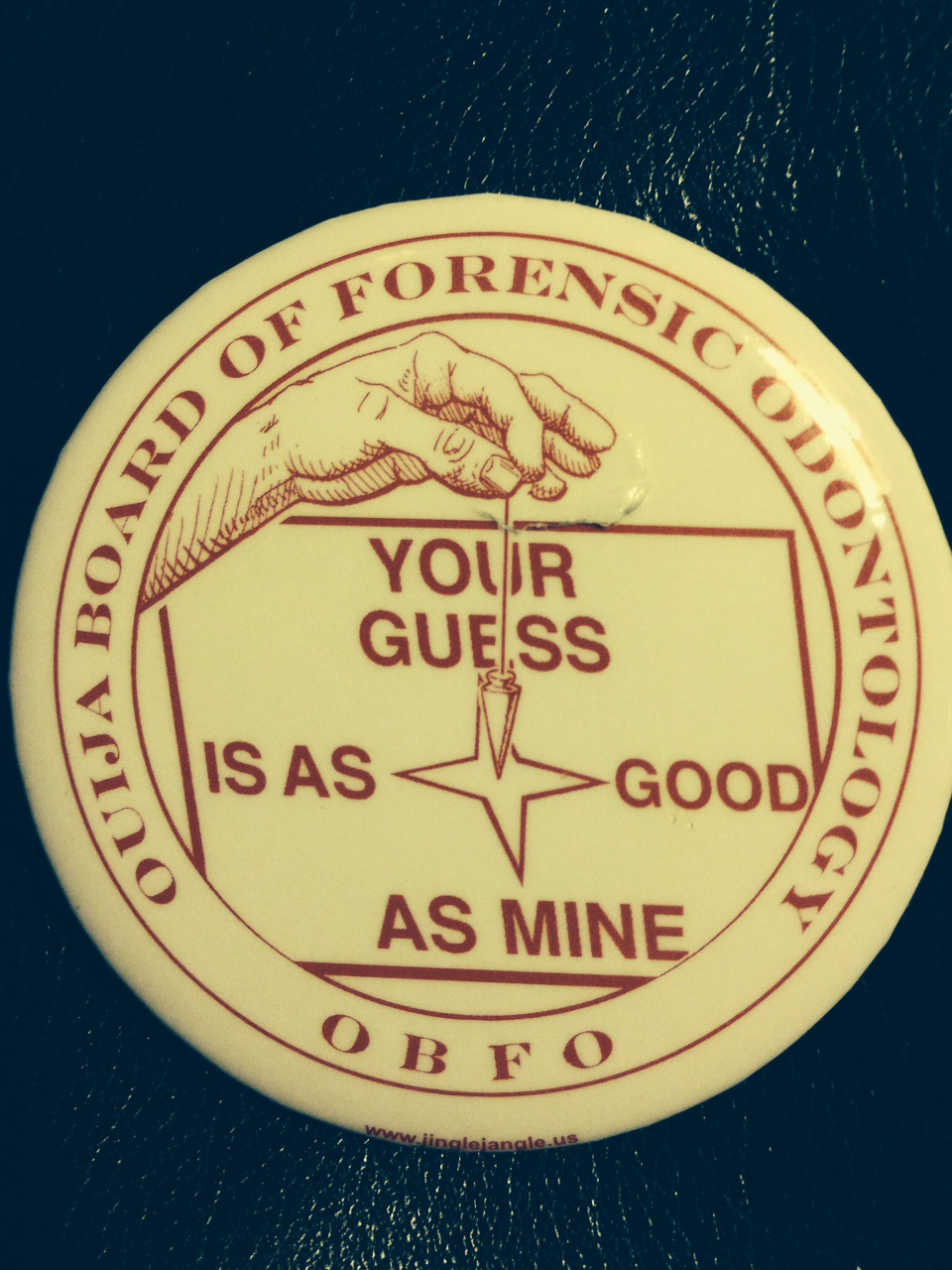
The Krone family was refused assistance by both organizations. One glaring conflict this dental group had was that one of their past presidents was the major prosecution bitemark expert, Dr. Ray Rawson in both trials. This denial (with no cause) left the family to ask individual AAFS/ABFO dentists to independently analyze one bitemark image to Ray’s teeth. 10% of the membership sent opinions and analysis data to Jim Rix, Ray’s cousin who spearheaded the family’s efforts to gain Ray’s release. I was one of those nine dentists. Jim wrote a superlative book on their experience titled “Jingle Jangle.” I think that is Jim Rix on the right in the top photo.  During those ten years, Ray’s stalwart defense atty from San Diego, Chris Plourd provided legal representation from the first trial to the final step of Ray’s exoneration. Chris is now a Superior Court Judge in the San Diego region. During the Krone family’s harrowing and frustrating battle with the ABFO regarding the org’s refusal to provide independent forensic review of the Krone bitemark evidence, a button ornament was made available at the next joint AAFS/ABFO convention that was quite popular with some of the attendees but not all of them.

OBFO Button

Photo credit: Dr. David Averill

Written below is the excerpt from The Republic article. The author is Michael Kiefer from The Republic. Also,  Here is the entire article. ================================================================In 1992 Noel Levy helped send Krone to death row for a murder he did not commit. Krone’s conviction and death sentence were thrown out three years later because the court had allowed Levy to present a videotape about matching bite marks into evidence that the defense had not had time to review. In 2002, Ray Krone was exonerated by a true DNA match. Krone was dubbed the “Snaggletooth Killer” because of his twisted front teeth, and Levy found experts who said that those teeth matched bites on the victim’s breast and neck. “The State’s discovery violation related to critical evidence in the case against the accused,” the Arizona Supreme Court ruled when it tossed the case. “Discovery” refers to evidence that the opposing attorneys are supposed to make available to the other side before trial. At retrial, Levy got another first-degree murder conviction for Krone, though at the second trial Krone was sentenced to life in prison, where he spent another seven years. In 2002, Krone was exonerated by a true DNA match; another man was convicted of the murder. “It never came out that one expert said it (the bite mark) wasn’t a match,” Krone told The Republic. There were footprints that didn’t match, DNA that was sketchy. And, as Krone said, other evidence was disregarded: an eyewitness account about a man seen near the crime scene who turned out to be the real killer, for example.


RELATED ARTICLES:

A Forensic Charlatan Gets Caught in the ACT. Some other bitemark                                                    disasters by AAFS/ABFO dentists.

RAY Krone receives  two settlements worth $4.4 Million. More                                                             case details


Posted in AAFS, Bitemarks, Exoneration costs, junk forensic science, Ray Krone bitemark case, wrongful convictions | Tagged , , , , , , | 1 Comment

Based on a notorius bitemark case: CA legislation plans to reject use of junk and outdated forensics in court @csidds

The story continues on the California Senate bill passage which would mandate the judiciary to competently assess the scientific weight of forensic evidence used to convict. If this passes into law, it would become a blue print for other state’s recognizing that proof of guilt or innocence via forensic opinions should be addressed using the scientific method, rather than legalisms derived from Old English Common Law traditions.

Earlier last week…

csidds's avatarFORENSICS and LAW in FOCUS @ CSIDDS | News and Trends

Radley Balko at the Washington Post’s “The Watch” announces California Senate Bill (SB1048) intent to direct the courts to consider scientific progress and reject junk opinions of debunked forensic methods and prosecutorial bias favoring “finality of verdicts.” He speaks to the proven unreliability (and overbearing forensic experts) of certain forensic methods. The AAFS /ABFO might want to take a look.

This bill is directly related to the 1997 murder conviction (aided by a bitemark “identification”) of William Richards in “tough on crime” San Bernardino county. Years later, Richards’ final appeal to the CA Supreme Court was based on exculpatory DNA and the DA’s bitemark expert reversing his original trial opine that a “bitemark” and Richards’ teeth were seen in only “2 out of a 100” adult humans. There was also a defense bitemark expert in 1997 who is the past ABFO president. He also rejected his 1997 testimony saying an injury…

View original post 90 more words

Posted in Uncategorized | Leave a comment