I contend…

This writer is a dear colleague of mine and definitely NOT a member of the ‘heralded’ American Board of Forensic Odontology. She is a full time death investigator working cases on a daily basis. As opposed to the standard  “occasional” forensic odontologist.

mbhauptle's avatarEye of the beholder

The use of information is power.  When asked (by Robert Toale, a lawyer who represented Abadie and Van Winkle), about his ‘margin of error’ in bitemark analysis, Michael West said, “Something less than my savior, Jesus Christ”.

There is no sense whatsoever in challenging the so-called ‘margin of error’ a specific scientist claims, in this case a Forensic Odontologist, about his or her confidence level in the professional opinion they render in bitemark analysis.  The true test is what the jury will believe.  And, I might venture, since there was a ‘CSI’ episode involving a bitemark, the jury will chomp on the bait.

The legal profession, in my opinion, must claim responsibility for the admissibility of this ‘bitemark evidence’, the testimony of the biased Foresnsic Dentist who delivered it, and the verdict.  Mike West was afforded the power to sway the jury, by the prosecution.  I think it is a heavy burden for gate keepers to determine whether…

View original post 101 more words

Posted in Uncategorized | Leave a comment

Tribeca Film Festival showcases “Dream Killer” docu on unjust justice

The interview revolves around and within Ryan Ferguson’s ordeal of 10 years in MO prison. Characters include makers of the Dream Killer documentary and what they say about those involved with Ferguson’s conviction and later exoneration. This is NOT fiction.

http://www.shockya.com/news/2015/05/07/tribeca-2015-interview-andrew-jenks-talks-dreamkiller-exclusive/

Posted in Perjury by Prosecutors, prosecutorial misconduct, wrongful convictions | 1 Comment

Monday’s Quick Clicks…

Much about states’ legislation compensation for exonerees. Plus judge talks about over incarceration. Plus what the innocent can do with their lives after leaving prison.

Mark Godsey's avatarWrongful Convictions Blog

View original post

Posted in Uncategorized | Leave a comment

A hatchet job succeeds in ousting DC crime director

When the cops want you gone, the politicos rush to assist…….the cops.

Read how a little “fair play” in sharing crime lab evidence to both prosecutors and defense counsel led to Max Houck’s resignation.

You should know the crime lab “certifiers” active in suspending the DC DNA lab for 30 days are all ex cop lab minions. One prominent ran the FBI bio lab.

Article

Posted in DNA mixtures, DNA profiling, Forensic Science Bias, forensic science reform | Leave a comment

A Post about “rapid” DNA evidence analysis being used by law enforcement. Claims include “exoneration of the innocent”

All the efforts in US crime lab science to avoid mishandling and incorrect processing or mis-interpretation of DNA samples may have a new “assist” from the “Rapid DNA” methods now commercially available and in use in a few police departments.  Though strangely, in the first PR article linked below. there isn’t any connection the police managed labs and the police “Rapid-D” being discussed. However, they do claim a “first to submit DNA data”using this method to the feds.

The PR piece is enlightening to say the least. In their pitch. they include a captivating pledge  “to keep communities safer and exonerate innocent suspects.” Bravo.

But if obstinate state and law enforcement  DNA archives and the FBI would start allowing exoneration counsel (i.e. Innocence Network, prison inmates and other legitimate defense counsel) full access to all the “bio-data” they are collecting, then maybe “exoneration of the innocent” would seem less cynical. This includes Arizona. Here is a brand new victory in  Montana where its state law has been changed to improve DNA access. It is a state-by-state battle.

In all this high tech excitement, this biological science modality is only one half of the equation of criminal investigation as it is only the suspect/perp side. This step adds one of two possible bits of information: 1) the suspect has previously left DNA during the commission of an older crime recorded in the FBI database or 2) the suspect was previously arrested. That’s it. So, its an aid for “cold case” resolution. Bravo. But……

Here is the other half of the crime fighting equation. The victims of crime and the crime scene itself. How about applying some “Rapid-D” to these? The PR piece leaves this part out.

Compelling needs for “Rapid-D.”

This “Rapid-D” has equal or greater necessity for the following scenarios.  Why not during victim interviews either at the scene or after a sexual assault during evidence collection (I hope) during a SART (sexual assault response team) exam. Lets make it a triple header by adding postmortem exams by qualified pathologists.

Im sure money is the reason “why not.” Its obvious in the media that crime fighting money and equipment money mostly goes to the police along with their share of asset forfeiture funds and a gazillion pieces of military equipment. Crime lab money? Not so much. Forensic science research? A mere blip, mostly given to small colleges. Forensic pathology: even less. Their numbers are decreasing anyway. Sad but true.

The primary bases of forensic science has always been the transfers of physical evidence between the perp and the crime scene and more modernly, via DNA, the victim. In this new era of “rapid” and so-called “touch” biological evidence, the building of a larger arrestee FBI database sounds great for “cold case” scenarios, but seems to be presented as a new ticket item for all investigations, when actually it is not. Or, not yet.  Because there is a glitch.

“Rapid-D” is being touted this way when crime labs themselves have very publicly shown ongoing glitches and slow processing their own backlogs of victim and crime scene DNA and, to a smaller extent, bumblers or whack jobs working in some labs. While some labs are still struggling, the FBI CODIS database will just get bigger from this “at the police station” resourcing.

To summarize: One system is lagging (crime labs according to media reporting), and the other  is expanding (CODIS). Poor coordination, to say the least. You can do “Rapid-D” all day long, but the goal is to have crime labs in the US uniformly capable of accurately completing their unknown evidence (from crime scenes, etc.) in a timely matter. Regardless of their limitations  in being police-managed and pseudo scientific in approach in some departments.

Back to the reality of now

The PR folks (talking about AZ LE officers entry into the world of DNA) acknowledge that this system (there are more than than one) can achieve a DNA profile of an arrestee in two hours which is then transmitted to the FBI CODIS archive. It is notable in that there is no mention of parallel “Rapid-D” submissions to the local affiliate law enforcement crime lab. Is this a one-way, stand alone, police driven collection and conduit only to the feds?  Maybe not.

My last. A new layer of  concerns regarding proper training, handling, etc., now land onto the custodial LE environment in addition to the crime laboratory environment.

ARIZONA CRIME FIGHTING advances to doing their own DNA in the station

PLEASANTON, Calif.–(BUSINESS WIRE)–IntegenX announced today that the Arizona Department of Public Safety (DPS) Crime Laboratory is using Rapid DNA technology to test DNA from qualifying arrestees for upload to the national DNA database. This capability streamlines the current process of DNA profile hit-matching against crime scene evidence, to keep communities safer and exonerate innocent suspects. Samples taken from the arrestees were analyzed using the RapidHIT system, which generated a full DNA profile in under two hours that was subsequently uploaded to the National DNA Index System (NDIS). NDIS is the highest level of the Combined DNA Index System (CODIS), which is managed by the FBI and enables the exchange and comparison of forensic DNA evidence from violent crime investigations across the US.

“Using advanced technologies such as Rapid DNA will fundamentally change the way law enforcement screens arrestees for links to unsolved crimes”

Vince Figarelli, the Crime Laboratory Superintendent at DPS, said, “This technology has already enhanced Arizona Law Enforcement’s ability to fight crime effectively through generating investigative leads. Now we have the ability to upload an arrestee’s DNA profile within two or three hours of an arrest. We now have the potential to assist other investigations while a suspect is still in custody.”

Full Article.

For those really interested in “rapid-D” here are some more links.

Maybe not the best idea for some. Cops doing their own DNA “rapidly.”

The FBI from 2014. 

The FBI promoting private industry to follow their “vision.” 


Posted in DNA profiling, Forensic Science | Tagged , | Leave a comment

Forensics revisionist talks to crimelabs about “some” 1200 exonerations as “innocence fraud.”

added 12-1-2016: we can now add the President’s Council on Sci Tech’s forecast of future directions needed within most crime lab methods. Once again the law enforcement “communities” choked on 178 pg report. That would be the FBI, US DOJ, fingerprinters, toolmarkers, District Attorneys and bitemark believers. 

This post came out in 2015.

At a recent notable meeting of crime lab managers in DC, the American Society of Crime Lab Directors (aka ASCLD : a police lab certification business)  a speaker reveled the audience with multiple accusations of that “in some” exonerations, there is ongoing fraud within within the small (in comparison to the law enforcement and prosecutor industry) community of exoneration litigators.

The theme of the speaker was a vapid announcement that a conspiracy exists within the forensic reform movement and that affiliated national networks of exoneration litigators are intentionally releasing  guilty prison inmates to go forth and prey on society. (see this presentation’s summary in today’s news release here). I am sure the speaker used his own funds for this. He is touting the upcoming release of his 10 years of research on wrongful convictions which is titled the “Innocence Audit.”

I am sure the promised paper will be compelling in unexpected ways. What he seems to be doing is self-promoting. Cases contesting the basis of an exoneration is in Chicago and is a total of one.  Out of 1200 [added: now up to 1800 by the end of 2016]. How many crime labs scandal have we seen on a monthly basis? 2 a month.

Here is what the ASCLD is all about. Initiated after private conferences with the FBI, the organization grew through the 1990s via assistance from the American Academy of Forensic Sciences and later established itself as a corporation in Missouri. (see “history” on the ASCLD website). It is strongly staffed and managed by those  law enforcement agencies they now inspect and certify. That is to be expected as the forensic culture is to self-certify itself. This subject been discussed before in the 2009 NAS Report on forensics and is largely evident in the current makeup of the National Commission on Forensic Science.

Here’s the general list of  clients and customers from the ASCLD website.

396 crime laboratories are accredited by ASCLD/LAB as of May 6, 2015. The list of accredited laboratories includes 190 state laboratories, 132 local agency laboratories, 31 federal laboratories, 18 international (outside the United States) laboratories and 25 private.

344 crime laboratories are accredited under the International Testing Program, 17 crime laboratories are accredited under the International Calibration Program, and 35 crime laboratories are accredited under the Legacy Program.

AS of this date, No labs have been decertified by the ASCLD.

So, in closing, here are a few comments of my own.

I will let the targets of his accusations respond to his “warning” to the ASCLD membership as he preaching a very slanted version of “forensic reform” .

It is rather ironic his audience were the very people who claim to be joining hands (considering the AAFS adopted all 13 recommendations of the NAS Forensic report merely a week after its publication) with the Innocence Project, the FBI, prosecutorial conviction integrity units and the criminal defense bar in the future prevention of wrongful convictions within the US Criminal Justice system.

The particular list of criminal justice “threats” he seems to love to go after is basically the core of what the public and media consider as the leaders in “forensic reform.” Here are some of them.

The Center for Wrongful Convictions (Chicago); The Innocent Projects throughout the US (about 35  based at American Bar Association accredited law schools; The National Registry of Exonerations; The Marshall Project and others associated with speaking out about faulty forensic science (and other factors in wrongful convictions) who oppose his theory that forensic work in the over 1200 exonerations listed in the National Registry  was nearly flawless. 

Against these organizations he praises a single reference paper for his opinions.


Posted in wrongful convictions | Tagged , , , | 8 Comments

Five commandments of “How to Reform Forensics” science and dumping the junk

By Radley Balko May 5 at 3:24 PM

THE WATCH

My favorite story of forensics malfeasance emerged from the North Carolina state crime lab a few years ago. I wrote about it at the time:

The relationships between SBI crime lab researchers and North Carolina prosecutors aren’t just cozy, they’re downright cuddly.The News & Observer reports that in one case two blood-spatter specialists ran through multiple experiments in order to produce even one that would make the blood patterns on a defendant’s shorts support the prosecution’s case. The two analysts are seen on video high-fiving after finally producing the desired result.

For those clinging to the notion that analysis in a law enforcement-managed laboratory can be independent, the newspaper uncovered prosecutor reviews of crime lab analysts indicating the contrary. In 2003, for example, prosecutor Ann Kirby, wrote in a review of a drug analyst, “If Lisa Edwards gets any better on the witness stand, the Johnston County defense bar is going to try and have her banned from the county!”

These weren’t a few rogue analysts; the crime lab’s problems extend across a wide array of forensic disciplines. Until 1997, the lab’s serology unit didn’t release negative test results as a matter of policy. If tests showed that a substance that police claimed was blood wasn’t in fact blood, analysts simply kept those results to themselves.

That story really hammers home the incentive problems in U.S. crime labs. Crime lab analysts are supposed to be neutral parties interested only in getting the science right. But the system is often structured in a way that makes them part of the prosecution’s “team.” In fact in many jurisdictions, crime labs actually get paid per conviction, not per analysis—about as clear a perversion of objectivity as one can imagine. Of course, the pressures and incentives needn’t be that explicit. For example, just knowing extraneous details about a case can produce cognitive bias, even in as accepted a field as DNA analysis.

There are two fundamental things that need to be done to reform the field of forensics. The first is to purge the courts of specialties that have no basis in science. With the fields that are left, we have to turn these incentives around, so that the performance of crime lab technicians is measured only on whether or not they perform accurate analyses.

Unfortunately, there has been very little discussion of the incentive problem among the various federal agencies charged with looking into reform. Possibly moving crime labs out from under offices of state attorney general or state police organizations is about as far as the suggestions go. They need to go further. Over at Reason,Roger Koppl, a professor of finance in Syracuse University’s Whitman School of Management and a faculty fellow in the school’s Forensic and National Security Sciences Institute, has some concrete suggestions.

  • Cross-lab redundancy.A jurisdiction should contain several competing forensic labs. Some evidence should be chosen at random for multiple testing at other labs. This creates checks and balances.
  • Independence.Put crime labs under the department of health, not the cops.
  • Statistical review.Compare the results of different labs and look for statistical anomalies. An investigation may reveal bad practices to be eliminated or good practices to be emulated.
  • Sequential unmasking.Forensic scientists can be biased by scientifically irrelevant information such as the criminal history of the suspect. Sequential unmasking is an administrative control process similar to that used in double-blind research studies. It prevents forensic scientists from learning potentially biasing information until after they have made their determinations.
  • Forensic counsel for the indigent. Most criminal defendants cannot afford their own forensic experts. Basic fairness says that they should have a right to their own experts just like they have a right to counsel. A voucher system is the best way to provide defense experts.

The cross-lab redundancy is key. If an analyst knows that every third or fourth test he performs — but not which test — will be repeated by another analyst in another lab, you’ve dramatically shifted the incentive. Even if he reports directly to the prosecutor, that analyst’s prime objective is to get the test right. If he doesn’t, sooner or later he’s going to get caught, embarrassed and possibly out of a job. Without this reform, the incentives are dramatically different.

By the way, this isn’t to suggest that crime lab analysts are corrupt. Cognitive bias creep into the work of even the most conscientious analysts. Scientists outside of forensics understand this, and take precautions to guard against it, like double-blind testing and peer review. Forensic analysis isn’t quite the same as the scientific method, mostly because it has different objectives. But if we’re going to give it the weight of science, we need to find away to subject it to basic scientific principals.

These ideas aren’t new. In fact, Koppl and I suggested them in Slate back in 2008. Back then, it was difficult to get policymakers even to acknowledge that there was a problem. That’s no longer the case. There is now a broad consensus that we’ve been using flawed science in our courtrooms, and that this has resulted in the conviction of innocent people (which of course often means guilty people go free). But the fact that a thinker like Koppl isn’t sitting on the president’s Forensic Science Commission while, for example, the federal subcommittee in charge of investigating bite mark evidence is loaded with practitioners of the very field that the committee should be investigating, suggests that the moment for forensics reform is in danger of passing us by, and that the apparatus put in place to do it may have already been captured.

Radley Balko blogs about criminal justice, the drug war and civil liberties for The Washington Post. He is the author of the book “Rise of the Warrior Cop: The Militarization of America’s Police Forces.”


Posted in Uncategorized | 2 Comments

Making use of their personal experiences of multiple injustices, Exonerees now come to court as lawyers

From the ABA Journal magazine

FREED AND PAYING BACK

Wrongly imprisoned, these men spent many years behind bars for crimes they did not commit. Plenty of convicted felons claim to be innocent; too many of them actually are. The criminal justice system stole from these men the carefree years of young adulthood. While many prisoners dream of going to law school, these three did it. Now they’re working to prevent others from suffering unjust imprisonments, and to eventually end the injustice of wrongful convictions.


Marty Tankleff

Photo of Marty Tankleff by Arnold Adler

MARTY TANKLEFF

It took an astounding array of forces to spring Marty Tankleff from a New York prison in December 2007: Armies of lawyers donated tens of thousands of hours—megafirms, small firms, plus Barry Scheck and the Innocence Project. A PR firm got his plight into the news. And there was a lot of luck.

Now he awaits his results on the New York bar exam. Tankleff, 43, until recently worked as a paralegal at the law firm that helped free him; and he is mapping out details for a nonprofit, possibly within the firm, in which law students will work at freeing the wrongly convicted when DNA evidence is not a factor. He also has been asked by a potential donor to explore the development of a program to give financial aid to struggling exonerees.

Arrested at age 17, Tankleff got an education in legal research and analysis in prison law libraries during his 17 years behind bars. He was sentenced to 50 years to life for the murder of his parents, Seymour and Arlene Tankleff, who were bludgeoned and had their throats slit late one night in 1988 in the wealthy family’s home in Belle Terre, New York, on Long Island.

Tankleff was released just days after a state appeals court ruled the trial court had been wrong to say newly discovered evidence pointing to the likely killer was not credible because some of the witnesses had criminal records.

He’s suing the police for using psychological manipulation to extract his false confession. Police flat-out lied to a weary, shocked kid in a classic interrogation trick that recently got the thumbs-down from New York’s highest court in another case. The state settled with Tankleff early last year for $3.4 million in his wrongful-conviction claim.

 Full article with three more stories

Posted in costs of wrongful convictions, criminal justice, exoneration, Forensic science misconduct, prosecutorial misconduct, wrongful convictions | Tagged , , , | Leave a comment

Incredible Costs of One Cop Detective to the Taxpayers of Chicago and Illinois; Big time Politicos on Crim Justice reform

This will never stop. Nothing like having questionable convictions coming back to haunt the the lawyers and the DA for the police of Chicago. Sun-Times Article

Hillary making sweeping statements on criminal justice reform. Wants to start with cops. And “mass incarceration.” Here’s a synop of her past opinions on the subject. 

And now US Republican majority leader John Boehner says…..nearly the same thing.

But the legal eagles say the State Prosecutor Marilyn J. Mosby has an uphill battle on convicting the 6 policeman she indicted for the death of Freddie Gray.

Regarding CJ (criminal justice) reform, try this case from OK as an excellent example. 

Holy crap. The city of Ferguson MO is paying a “note attorney” $1335 an hour for his wise council. Multiply that by the almost 5,000 law enforcement agencies in the US when they run into problems with “force application.”


Posted in Civil rights, criminal justice reform | Tagged , , , | Leave a comment

Highlights of the 2015 US Innocence Conference held this last weekend

For those less likely to be following what is happening in civil rights and exoneration litigation, this meeting in Orlando FLA was the gathering to see the impressive depth of dedication, legal expertise and energy present in this growing movement.

The meeting was a blend of the myriad groups belonging to the Innocence Networks (both in the US and internationally) with their litigators, volunteers and law students. The center point for this event were the many exonerees who attended. The impact of their presence was then combined with their personal storytelling.

The 2015 Innocence Network Journalism Award was presented to @radleybalko for his amazing work covering & contributing to justice. The award is for his recent series about bitemark’s damage to human lives and the criminal justice system. “The path forward on bitemark matching and the rear view mirror.” 

What is most ironic is that mass media is more about #Baltimore this weekend. The 4th estate was totally mum about this meeting of one compelling aspect of criminal justice that underlies what is happening in Baltimore.

Readers of this blog will have to access Twitter for more comments and stunning fotos available from #INConf2015

@innocence

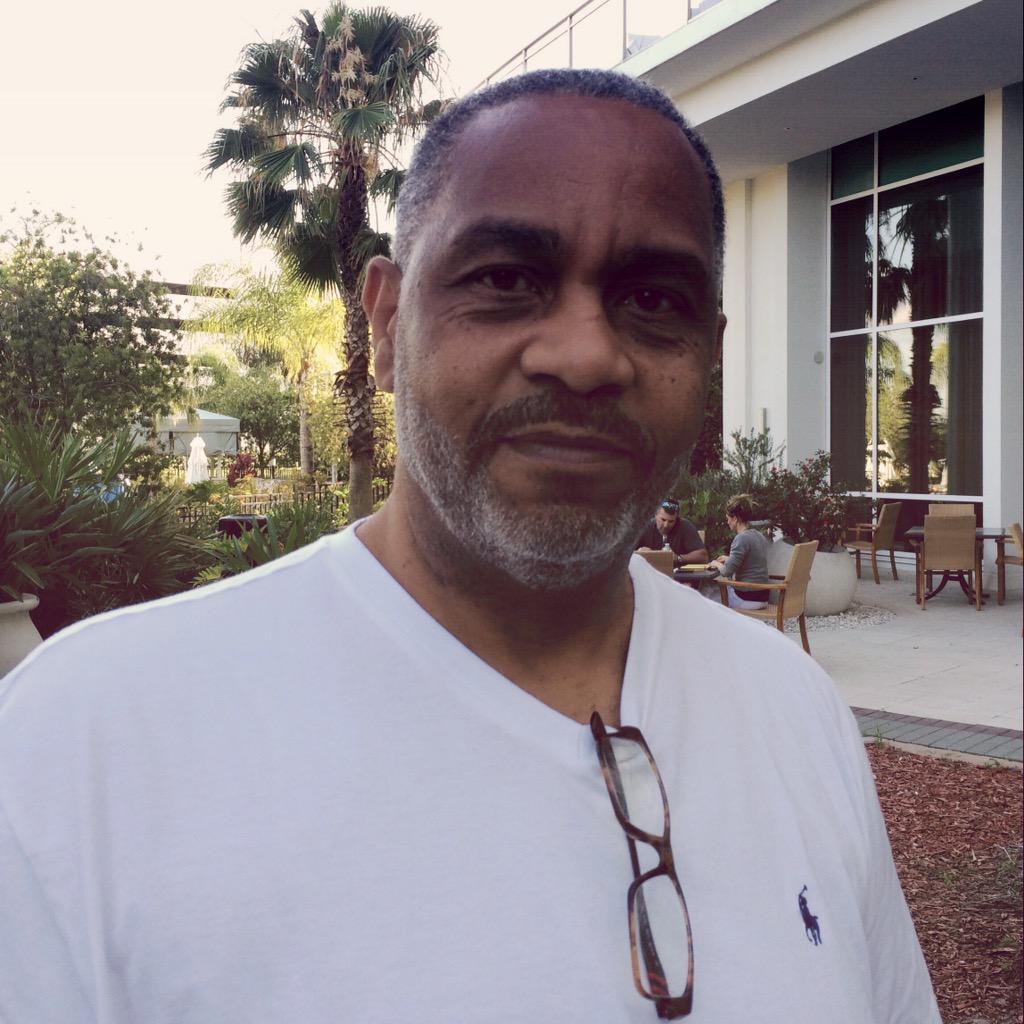
Anthony Hinton, exonerated 30 days ago from death row after 30 years of wrongful imprisonment, is here at .

 Embedded image permalink

Embedded image permalink

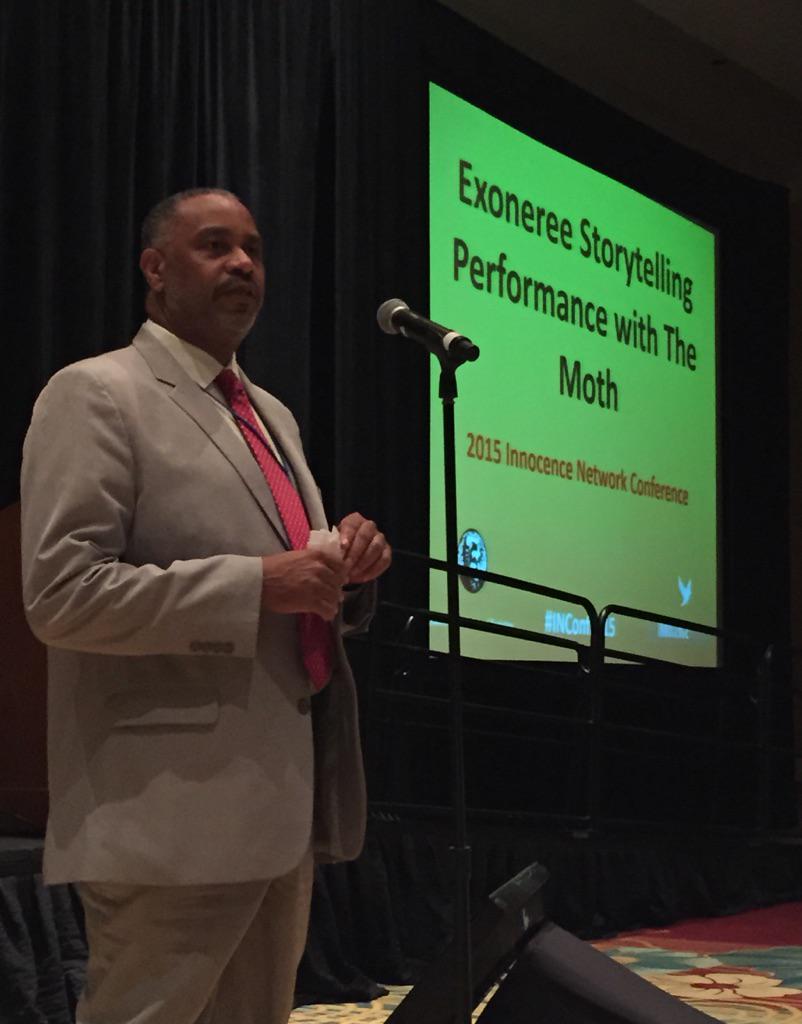
Anthony Hiton speaking to #INConf2015

Embedded image permalink

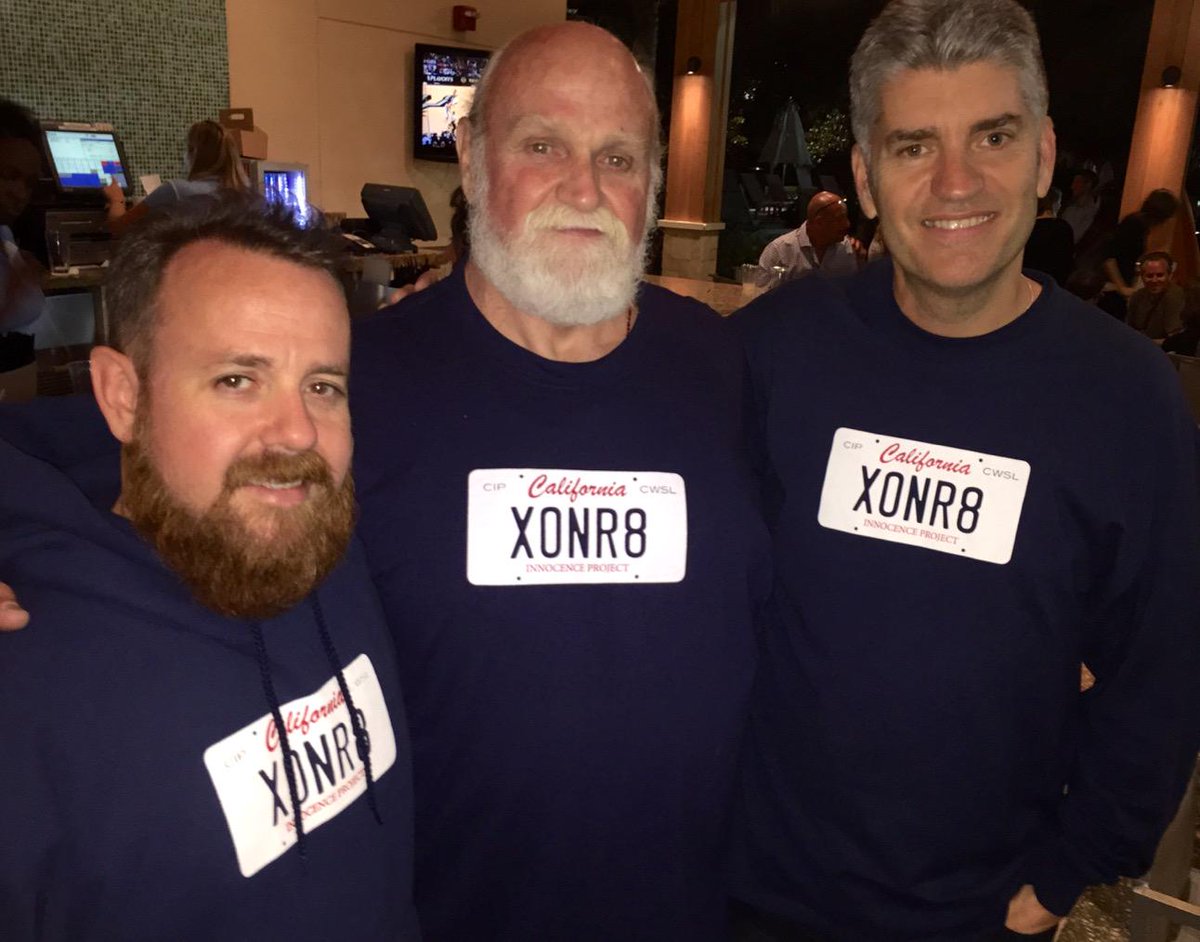
California 2015 exoneree, Michael Hanline (36 years in prison), with Cal Inn Project’s Justin Brooks (r) and Alex Simpson (l). @CA_Innocence


Posted in Civil rights, costs of wrongful convictions, criminal justice, exoneration | Tagged , , | Leave a comment