Fabrication of bitemark evidence by dentists not proven according to 7th Circuit dismissal of Stinson civil suit

“Fabricated opinion evidence, for which the expert might not have qualified immunity, must be both wrong and known to be wrong by the expert,” Sykes explained (an appellant judge recently wrote this in WI).

Its quite clear in Wisconsin that incorrect expert opinions must derive from “falsified or made-up” opinions intentionally created for use by the prosecution. Illinois thinks the same.

There exists no remedy for mistakes, exaggerations of certainty opinions unsupported by science,  or incorrect assumptions used by forensic experts to form conclusive opinions of a defendant’s criminality in the United States. A recent opine (also dismissing expert liability for AAFS dentists hired by the prosecution) in another civil case brought by DNA exoneree Bennie Starks from Illinois, concluded with the trial judge’s ad hoc statements assessing the prosecutorial use of bitemark dentists akin to “palm reading and astrology.”

Harm was heaped upon both men (both African Americans), but appellate case law accepts this as not a foul.

A legal opinion from my POV. 

There is  a gaping disconnect between forensic “inaccuracies” ( or worse ) affecting the outcomes of criminal cases and the defendant’s much judicially lauded “civil rights” to a fair trial  etc etc. Judge Sykes found “no constitutional” basis in Stinson’s  complaint of wrongful conviction. Loss of liberty (his was not a capital case demanding execution, but others have been put on death row) gets a pass. Even if the White House Office of Science an Technology Policy and the National Academy of Science have discredited the “bitemark matchers” in toto.

Thus, the Stinson v. Gauger, Nos. 13-3343, 13-3346 & 13-3347 (Aug. 25, 2015) civil suit against AAFS/ABFO dentists Tom Johnson (the WisBar author incorrectly calls him Lowell Johnson, which in itself is humorous to some experienced ABFO forensic dentists) and Raymond Rawson by an exonerated Robert Lee Stinson failed on its appeal to a Seventh Circuit Court of Appeals 3 judge panel. Both dentists are super-icons of the AAFS, the NIJ (Johnson received a record-breaking $715,000 NIJ grant for bitemark research a few years back), and the elite of the ABFO. Rawson was at the epicenter of exoneree Ray Krone’s death row conviction in Arizona in the 1990’s.

The term “qualified immunity,” as applied to district attorneys, police and their hired experts in criminal cases, is their  cornerstone of liability protection according to the US Supreme Court and state courts. Exoneree from Texas Michael Morton (25 years in prison) may have obtained some satisfaction when the DA from his conviction finally experienced some comeuppance a couple years ago. In Morton’s case the DA misdeeds were deemed intentional.

Note: The Stinson conviction from more than 23 years ago, regardless of it becoming a DNA proven exoneration, still appears in certain state’s case law as proof of bitemark “matching” continuing acceptance in courts.

Does this sound like an episode from The Twilight Zone? I may be dating myself.

Full article from Wisbar.org


Posted in AAFS, ABFO, Bite Marks, Civil rights, costs of wrongful convictions, criminal justice, CSI, death penalty | Tagged , , , , , , | Leave a comment

Its all about cheese for this bitemark expert

An overview of forensic dentistry in Australia. The author uses a 1954 cheeze bite case as a standout. Some what wrong as it misses all the faulty expert opines helping wrongful convictions. The remaining info on identifying human remains is spot on.

http://m.goldcoastbulletin.com.au/news/crime-court/dentists-urged-to-keep-records-of-patients-history-to-solve-crimes/story-fnje8bkv-1227495503548

Posted in Bite Marks, Bitemarks, CSI, Forensic Dentistry | Leave a comment

US Army Crime Lab enters the realm of “personal DNA” sequencing looking for hair an eye color

Battele Inc’s research leader used to run the FBI DNA nuclear DNA unit. Now his company is coming into the big game of identifying human physical traits from genomic DNA “markers” (ie.e alleles) not used in current criminal science systems.

Having received a $880K grant from the NIJ, this company announces that the US military’s forensic center (ex CID crime lab) has signed on to purchase their EactID methods.

Now thats a name worth copyrighting. “exact’ is gold in the forensic business. They do have decades of legitimate DNA progression to rely upon. This is not unlike medical researchers searching the entire human genome for disease creating genetic sequences.

“ExactID provides the information needed to determine specific, identifying traits — such as hair and eye color, race, who a person may be related to, where they may live — from an unmatched DNA sample. This has not been possible before.”

Thus the company has entered the “personal genetic trait” business much like labs connected with Ancestry.com, deCODEme, and Family Tree DNA.

Their full pr article.

Battele is urging other law enforcement to join up. But I’m curious about implementation as their pr blog says this “As use and reliance on the data produced by ExactID increases, Battelle experts expect other law enforcement agencies to adopt it in their investigations.”

It appears that the US Army will be a “proving ground” for this company’s product.  That means the rules of evidence regarding this product’s accuracy rate, error rate, etc., will be reviewed by the military UCMJ rules and a very limited case history on admitting expert testimony. Seems problematic to me regarding “next generation” DNA sequencing (Battele’s phraseology) as the military courts are weak on “new science” the admissibility front.


Posted in Crime, CSI, DNA profiling | Tagged , , , | 3 Comments

Deep into false forensic science from the FBI

Hair analysis ‘should be abolished,’ says wrongly incarcerated man


1978 Double murder.

37 years in prison.

“He said that the pubic hair was microscopically similar to mine—microscopically similar.”

Joseph Sledge was no saint, and the police knew it. Then the FBI got involved.  Once DNA got to be very popular, he then ran into the not unusual resistance from law enforcement to get crime scene and biological evidence tested and brought forward  into appellate level exoneration litigation.

In “Under the Microscope: The FBI Hair Cases,” Fault Lines looks at how, for decades, the FBI used the flawed forensic method of microscopic hair analysis to convict thousands of criminal defendants. The film airs on Monday, August 17, at 10 pm Eastern time/7 pm Pacific on Al Jazeera America. | Click here to find Al Jazeera in your area.


Posted in Civil rights, costs of wrongful convictions, criminal justice, CSI | Tagged , , , , , | 1 Comment

Some DAs wandering afar from ethical guidelines

Leaking prosecutors seem to be getting some attention from the FEDS. But they ultimately get slapped on the pinky finger. As in prosecutor Mike Nifong in the Duke rape railroad case getting one day in jail.

Its even worse when the wrongfully convicted (mostly African Americans) get exonerated from years in prison, get no compensation from both those who prosecuted them an their junk forensic science experts. 

USNEWSOPINION


Posted in AAFS, ABFO, costs of wrongful convictions, Crime, criminal justice, criminal justice reform, CSI | Tagged , , , , , | Leave a comment

PRADE: Ohio defendant gets a 2d evidentiary hearing regarding DNA from coat sleeve over a bitemark

Douglas Prade was previously considered for release in 2013,  “….. based on advanced DNA testing that excluded Prade from crucial crime-scene evidence — a bite mark under a lab coat worn by Dr. Prade [the defendant’s wife] on the morning of the slaying.” This was immediately appealed by the prosecutor who convinced the higher courts “arguing that her [the judge in 2013] findings were meaningless because the lab coat most likely was contaminated over time, and Akron’s 9th District appeals court strongly supported the government’s argument.”

I love it when lawyers use “most likely” as an argument against scientific evidence that doesn’t support their arguments. Its like they can pull facts and conclusions out of thin air at the drop of a hat whenever they need it. Its a lawyer’s opinion, not a scientific one.

Note worthy is the prosecutor’s silence about the State’s bitemark dentist’s opinion of Prade’s teeth making the bitemark (another total guess). Maybe that dentist might need to re-review the latest judicial opinion out of Illinois aligning bitemark experts with astrologers. Plus the White House director of Sci and Tech Policy very recent public statement that bitemark evidence should be “eradicated.”

Full article from Akron OH


Posted in Uncategorized | Tagged , , , , , , | Leave a comment

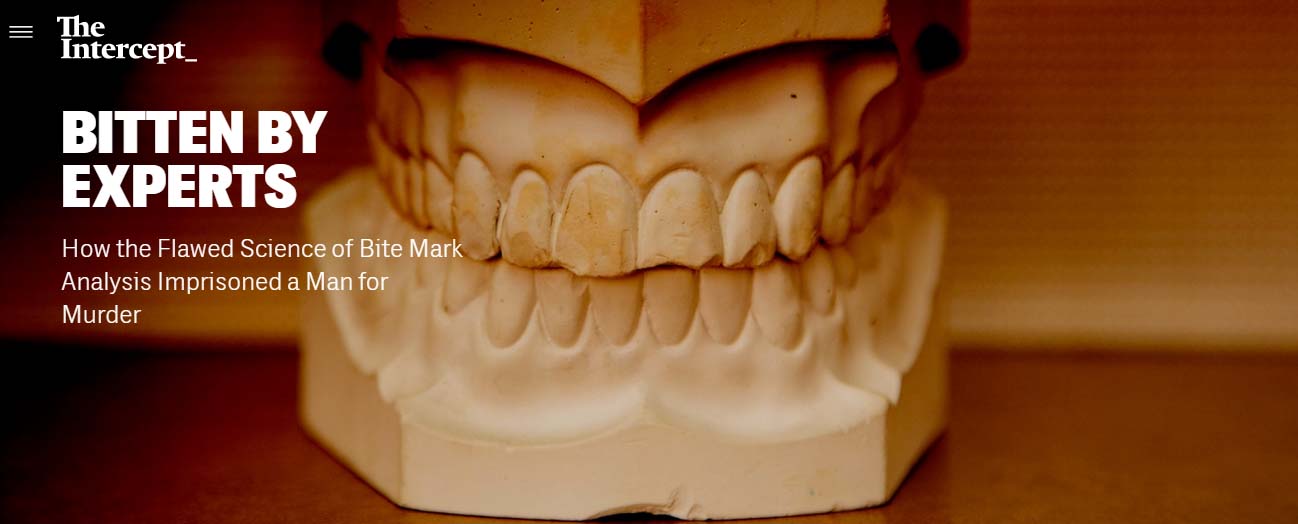
Bitten by Experts: Forensic Science at its worst.

The Intercept copy

An in depth analysis of the Bill Richards case now re-litigating before the CA Supreme Court. From The Intercept by Jordan Smith @chronic_jordan.

A previous CSIDDS blog on this case. 


Posted in Uncategorized | Leave a comment

TX arson case of three decades ago gets a new trial and exposes the gap between science and prosecutions

A long read from Slate but is worth every minute. See how circumstantial evidence (the “bad man” and “liar” collar given to defendants,” and revived “memories” of eye witnesses from long ago impact defense attempts to reject the impregnable original story that a crime and double murder of two children occurred.

Slate

Thanks to Mark Godsey at the @Wrongconvblog.

Posted in Crime, criminal justice, criminal justice reform, CSI | Tagged , , , | Leave a comment

Forensics: Bitemark matching in “India” Documentary

I would love to see the “bitemark” police talk about in this recent case. The authorities should rely on DNA obtained from the bitemark itself not a bitemark “fingerprint.”

BBC documentary

Previous blog on India’s bitemark expertise. This may be the same case.  https://csidds.com/2015/06/27/there-are-some-problems-with-indias-forensic-system-bitemarks/


Posted in Bite Marks, Bitemarks | Tagged , , | Leave a comment

Forensics: Another case of a “recaptured” bitemark showing “unique” features matching one man in the world.

This comes in three parts:

Part One

This is the long range photo of a bitemark determined so by two ABFO bitemark dentists Michael Sobel and Tom David.

Here is a color closeup on the left and a UV picture taken months later. The dentists considered the UV pic to show “unique” characteristics of just one man, the defendant John Kunco.

Kunco -1990-91 copy


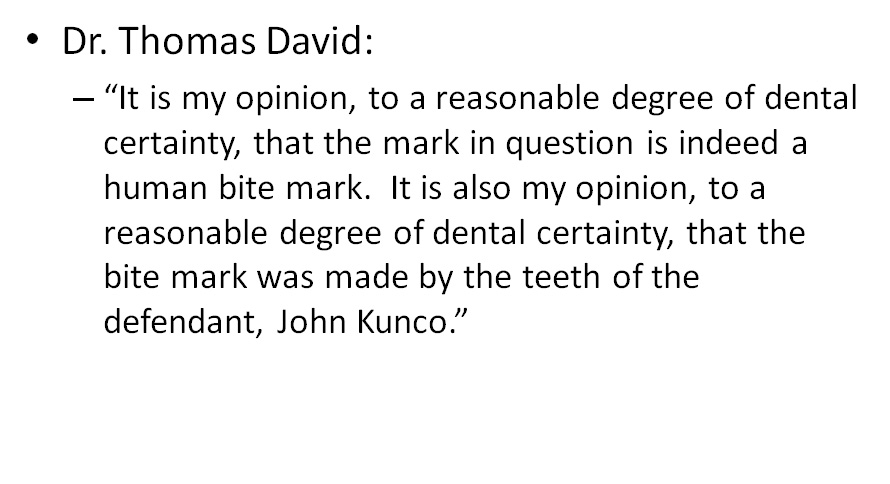
Here are some quotes from these well-respected members of the AAFS and ABFO.

Sobel copy

TDavid copy


Part Two

Bitemark Evidence in the Kunco Case

The bitemark evidence in the Kunco case consisted of a photograph showing a bitemark on the shoulder of the victim. The bitemark evidence became case critical when the 40 pieces of physical forensic evidence recovered at the scene, which included hair, blood and fiber did not link to the suspect John Kunco. The authorities then consulted a board certified ABFO forensic dentist five months after the crime.

The consulting forensic dentist explained that a scale in the photograph is necessary for the bitemark comparison process. The forensic dentist recalled hearing about a technique that Dr. Michael West developed using UV photography to penetrate the skin in order to capture bruising that still exists below the skin. He believed that he might be able to “see” the old bitemark now not visible through the use of UV photography. The forensic dentist consulted a colleague and photographed the area on the shoulder with UV light. It is from this photograph 5 months after the bite to the shoulder that the intricate details of the biter’s teeth are described through “skin reading”.

Full 2011 article from Dr. David Averill’s blog

Part Three

2011 Court Denies Kunco Relief in “Recaptured Bite Mark” Case

The Innocence Project first took this case on in 1993 and appealed on the basis of the novel UV photographic technique the experts used to “recapture” the bitemark 5 months later. The experts learned the technique from former ABFO member and now dis-credited forensic analyst, Dr. Michael West (see previous post). The Innocence Project used Dr. Gregory Golden as the forensic dental photography expert who testified that the UV reflectance photographic technique was unreliable. He was opposed in court by Dr. Robert Barsley who the court felt satisfactorily rebutted Dr. Golden’s testimony since some sort of marks could be seen in the UV reflectance “recaptured photograph” purported to be a bitemark. There was no discussion at the time surrounding the ability of this bitemark without details to be used to identify a specific individual. Historically this was at a time when bitemarks were being used and accepted in the courts across the country with an irrational exuberance. It was only later as DNA that has been recovered from many of these overstated and unsupported opinion bitemark cases that the reliability and validity of bitemarks have come under intense scrutiny and question by the media.

Full article from www.bitemarks.org

Also, in 2011, THE AGITATOR has further discussion on Kunco by Radley Balko.

Comments:

This comes on the heels of the Texas Forensic Science Commission’s edict last Friday that all Texan bitemark cases were to be reviewed, I suggest that Pennsylvania courts do the same.

Readers should also note that Dr. Robert Barsley (the state expert supporting the Kunco trial bitemarks experts, is now (2015) chairman of the National Commission on Forensic Science bitemark committee. 

Thanks to Craig Cooley in providing valuable information in this post as he was the principal litigator in John Kunco’s appeal.

Craig M. Cooley
Cooley Law Office, PLLC
PA Offices: Pittsburgh, Philadelphia
NC Office: Cary
 
State and Federal Post-Trial, Criminal Appeals,
Post-Conviction, Habeas, and Innocence Litigation


Posted in AAFS, Bite Marks, Bitemarks, CSI, expert testimony, forensic science reform | Tagged , , , , , , | Leave a comment