Forensics: Bad grades in DNA lab proficiency tests leads to nastiness in court

Police crime labs and their forensic certifiers are still making serious mistakes.
http://www.huffingtonpost.com/2011/06/14/the-case-for-private-crime-labs_n_876963.html

csidds's avatarFORENSICS and LAW in FOCUS @ CSIDDS | News and Trends

This is an update from yesterday’s report on the SFO crime DNA lab getting hammered for insufficiencies. Full article. The next link is also related to this topic.

SFO Distrist Attorney now going after an investigation of the SFO Police, Sheriffs, and their crime lab. Full article.

DNA specialist in a double murder trial raises some honest doubts by saying cross contamination cannot be ruled out as reasoning for the defendant’s clothing possessing the victims’ DNA [aka “mere specks”]. Full article.

BS public relations release about how the FSAB (forensic board certifiers connected with the American Academy of Forensic Sciences) says that all is ok with a fire-science-arson certification group. The FSAB also says the AAFS bitemark group (ABFO) is another sterling example of scientific prowess.   Full article.

View original post

Posted in Uncategorized | Leave a comment

The bloom is off forensic DNA’s infallibility – Scientific American

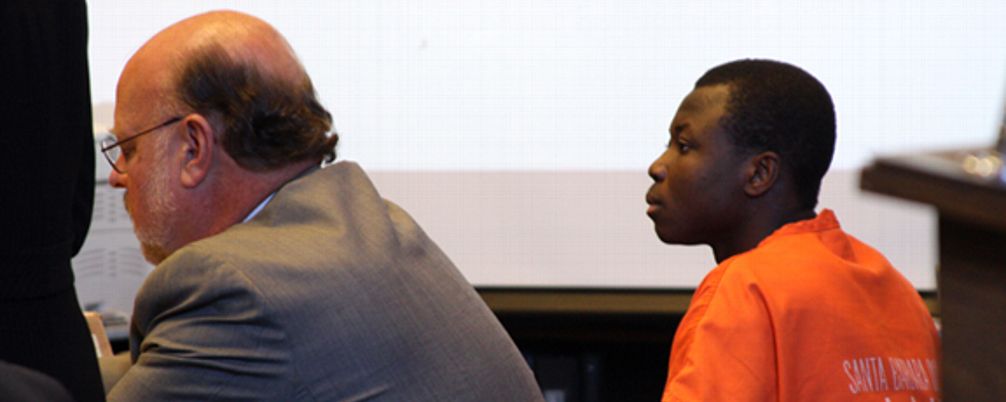
Eric Frimpong and Santa Barbara defense attorney Robert Sanger in 2008.

With the FBI making a step to reel in its history of wayward forensic conclusions, Scientific American wades into the “restructuring” of DNA opinions in much the same way. The Fibbies had ample time and warning to rethink and retool their poorly validated use of human hair morphology when DNA profiling began to contradict hair IDs in earnest during the 1990’s. Better late than never, I guess.

Now, in a stroke of irony, DNA is being seen in the media and some scientific forensic circles as subject to similar human foibles. Starting with unintentional transfer of a suspect’s DNA to some other crime scene to much worse.

Its all about the DNA from “touch.” The Santa Barbara’s District Attorneys Office put UCSB soccer star Eric Frimpong into prison (and after release deportation back to Ghana) in 2008 from a touch contact between a female student and his genitals. She was covered in seminal fluids from her unindicted “boyfriend.”  2 bitemark dentists showed up to finish the deal against him. These are same two DA bitemark experts in Bill Richards case from 1997 who recanted their testimony from that case in 2009.

As you will read below, “touch” research is just starting after 20 years of DNA courtroom opinions in the US. In another irony, the testing of DNA “walking” into a crime scene and by direct inference, a sexual assault case, is reported from a forensic science graduate student. Odd? Not really as this is forensics.

When DNA Implicates the Innocent

The criminal justice system’s reliance on DNA evidence, often treated as infallible, carries significant risks.

Until recently, this type of DNA has been regarded as incontrovertible proof of direct contact. But a growing number of studies show that DNA does not always stay put. For example, a person who merely carried a cloth that had been wiped across someone else’s neck could then transfer that person’s DNA onto an object he or she never touched, according to a study published earlier this year in the International Journal of Legal Medicine. Similarly, Cynthia M. Cale, a master’s candidate in human biology at the University of Indianapolis, recently reported in the Journal of Forensic Sciences that a person who uses a steak knife after shaking hands with another person transfers that person’s DNA onto the handle. In fact, in a fifth of the samples she collected, the person identified as the main contributor of DNA never touched the knife. Cale and her colleagues are among several groups now working to establish how easily and how quickly cells can be transferred—and how long they persist. “What we get is what we get,” Cale says, “but it’s how that profile is used and presented that we need to be cautious about.”

Full article from Scientific American.


Posted in AAFS, criminal justice, DNA profiling, Forensic Science | Tagged , , , , , | Leave a comment

Advancing forensic science by the California Supreme Court took 7 years


A “unique bitemark” proved Bill Richards’ guilt

2016

Seven years after being exonerated and 23 years in prison, Bill Richards, due to the CA SC’s most recent opinion, now waits in jail. The DA of San Bernardino County has 60 days to re-charge Bill for the 5th time. More on the story from this blog posted on June 10, 2013.

2013

After my beginning comments,  an article follows that recently appeared in NPR’s “Around the Nation”

I am posting it for a number of reasons.

First, I have been active as an appellate forensic expert in the Richards’ case for 16 years.

Second, the litany of forensic fumbling and junk criminalistics opinions brought by the prosecution to his final trial has convincingly been discredited over the years. The case’s botched crime scene investigation is a prototype for a “perfect storm” of errors and omissions in evidence collection and interpretation. The success of a habeas corpus hearing in 2009 where Richards’ innocence was judicially accepted in light of the bitemark expert recantations of earlier testimony and post-conviction investigation and recovery of multiple male DNA profiles described below is now moot.

The third reason, which is related to reason #2,  is the Supreme Court in California consideration that Richards’ proofs of innocence to be incomplete and un-compelling. The court’s rationale indicates the “finality of verdict” (mentioned in the following article as a foundation of justice) takes legal prominence that overcomes niggling claims of innocence for forensic advances. This mindset is intellectually deficient and beyond arrogant.

Just like juries that ignore the evidence to reach a verdict contrary to the law engage in “jury nullification,” the SC judges substituted their policy preferences for common sense.

In Richards, the Supreme court has determined through its wisdom that “unerring proof” is necessary to overturn a conviction without including a definition to lead us all to any finite determination of what THAT standard means. So in nullifying the previous standard of proof. the court offers us a paternalistic replacement which only indicates that they “know it when they see it” result.

===================================================

NPR 2013

William Richards was convicted of brutally murdering his wife and is now serving 25 years to life. The evidence against him was circumstantial and contained trumped up “science” experiments from prosecution witnesses. Two juries were unable to reach a verdict and a third trial was dismissed because the judge quit the bench during the proceedings.

But at the fourth trial, the San Bernardino, CA, prosecutor introduced for the first time testimony about an injury on the victim’s hand. Forensic dentist Norman Sperber analyzed an autopsy photographs at this trial, and pointed out marks that appeared to be spaces between teeth marks made by human teeth. The spaces indicated a single tooth was misaligned. William Richards had a crooked tooth of the same misalignment which seldom was seen in the human population. According to Dr. Sperber only “1 or 2 out of a hundred” people possessed this dental anomaly.

Richards was convicted at this trial in 1997. Ten years later, another forensic dentist corrected a distortion in the picture using photo-editing software.

“If I had known that technology would help me be more accurate, I definitely wouldn’t have testified as I did,” Sperber says. He now believes Richards could not have made the bitemark and questions if it’s even human.

OLD CASES, NEW DOUBTS, NEW DEMANDS FOR JUDICIAL REVIEW

Similar cases are arising around the country. Defendants have been exonerated or received new trial in Wisconsin and Texas. Last summer, the U.S. Department of Justice began reviewing thousands of convictions because of flawed forensic science.

In California, the state Supreme Court denied Richards’ request for a new trial, saying that Sperber’s new analysis a decade after the trial didn’t “ unerringly point” to Richards’ innocence.

Jan Stiglitz, one of Richards’ attorneys and co-director of the California Innocence Project, says the court set an impossibly high bar.

“We know that the linchpin in this trial was the bitemark evidence,” he says. “We now have experts who have come forward and all said this is not a mark that was made by Richards’ teeth. And yet Richards is going to spend the rest of his life in prison because the Court says he can’t affirmatively prove that he didn’t commit the crime.”

But Jan Scully, past president of the National District Attorney’s Association and district attorney for Sacramento County, Ca. takes a different view. “We need to have finality of verdicts,” she says. “There is always a new opinion or there might be a refinement in our forensic science areas. So, just because something new occurs doesn’t mean that the original conviction somehow was not valid.”

Whether Scully was speaking only in broad terms, this statement flies in the face of the facts in Richards’ case. Hair and blood DNA taken from the victim and from the murder weapon does not match Richards.

As more studies, highlight major flaws with forensic science, challenges to convictions will continue to arise, says Georgia State University’s Jessica Gabel. She says criminal appeals usually involve a so-called battle of the experts.


Posted in Bad Forensic Science, Forensic Dentistry, Innocence March, William Richards Exoneration Case | Tagged , , , , | 2 Comments

Forensic Science Reform: Justice Department issues first standards for forensic expert testimony

Deputy Attorney General Sally Q. Yates speaks on Capitol Hill in Washington in Oct. 2015 (Carolyn Kaster/Associated Press)

The top US government agency involved in funding and management oversight of the FBI forensic science community just put out “guidance”on forensic testimony and associated documentation. It still will be up to the myriad police crime labs to follow/ignore/ignore again these rules. One stated aim is “clearing the innocent.” Tell that to some DAs I have encountered over the years. Some have perfect records of conviction.

The multi-forensic science and police science guidance on testing, report writing and testimony is here.  Public comments can be posted here. (somewhere).

Here is a comment from Peter Neufeld.

“However, he said, “It’s remarkable that the FBI developed internal standards for decades, without ever subjecting those guidelines either to public comment or more importantly, to the scrutiny of the nation’s leading experts in statistics and probabilities, with the exception of DNA,” Neufeld said. “But we hope this is the beginning of a new era, and we applaud that.” ”


Full article from the Washington Post’s Stephen Hsu.

Posted in Uncategorized | Tagged , , , , | Leave a comment

Illinois crime lab responds to state law allowing police to ignore Discovery of forensic testing

Lets just say that the police  “commenting” about a bill passing through the Illinois legislature that supports non-disclosure of crime lab testing processes is similar to police agencies not being forthcoming with police body camera recordings. Besides the fact that the police emailing person seems to be cryptic and not really explanatory in any real sense.

This type of state control of crime lab internal testing and evaluation reports should become very popular in other jurisdictions.

Full article containing the police crime lab response to criticism from the criminal defense bar. Some quotes:

Defense atty:

“The purpose of the law is to prevent the defense attorneys from getting any of the information we have been able to get in the past. They are going to try to set up rules so the mistakes and errors don’t become the types of information they have to turn over any more,” said Ramsell.

Police crime lab:

“The ISP endorsed Amendment #3 to SB3096 to ensure the integrity and consistency of lab toxicology reports presented to the courts and to not limit disclosure,” according to the emailed response.”

Previous news article. 


Posted in Uncategorized | Tagged , , , | Leave a comment

Illinois crime lab bill created to seal faulty testing from public view

Image result for forensic mistakes

Cases of government-run crime labs  “hiding” forensic errors and gaffs from criminal defendants and the public got a boost in Illinois this week……We can use this to clearly understand who and how prosecutors and LE PACs control the legislators in certain states. Illinois taxpayers have already spent millions of $$ paying for wrongful conviction compensation lawsuits. This bill seems to exacerbate that problem.

“Under a new law passed by the Illinois House yesterday, Ramsell says state police will be able to withhold some of the most crucial crime lab information. Including, he says, the kinds of mistakes uncovered by the I-Team last year. These mistakes included: test samples switched, names that didn’t match, wrongly run vials of evidence, general inaccuracies, incorrect methods and destruction of evidence.”

http://abc7chicago.com/news/new-law-could-hide-forensic-failures-from-public/1367365/

Posted in costs of wrongful convictions, Crime lab scandal, criminal justice reform, Exoneration costs, forensic fraud, forensic science misconduct | Tagged , , , , , | Leave a comment

Forensic look at death penalty statistics: 25% of exonerated were on Death Row

A 2013 infographic study by the California Innocence Project puts the cost in California at a staggering $4 billion since 1978. Statistics contained in this report, when overlayed with the national increase of exonerations ( now at 1793) , in the US runs counterpoint to the presence of the death penalty (subject to decades of appeals) as a constitutional (8th amendment) “deterrent” to violent crime.

The forensic science connection comes from the sad fact that of the 1793 exons, an unacceptable number of  forensic examiners have fumbled the ball regarding false  or misleading testimony. See the cases. 

exonchartcontribs copy


Posted in AAFS, costs of wrongful convictions, criminal justice, criminal justice reform | Tagged , , , , , , | 1 Comment

California Supreme Court determines advances of forensic science sufficient to vacate conviction

Its all about 2 bitemark opinions from a murder trial.

In an unanimous 7-0 decision, the court’s holdings vacates Bill Richards murder conviction from 1997 and makes his imprisonment since 1993 subject to release from prison and opens up future exoneration proceedings. Richards had a successful 2009 exoneration overturned on appeal by San Bernardino County’s DA Michael Ramos and the state’s Attorney General Kamala Harris who is now running for the US Senate.

The telling points made  by this court in Richards’ favor were enabled by its using the 2014 new California “junk science” Penal Code statute 1473 created directly because Richards’ appeals. His 2012 attempt to prove evidence of his guilt from a pair of bitemark experts was “false” failed in what this court calls Richards I.

Background from Richards’ 1997 4th trial for murder.

Previous to 1997, there were 2 hung juries and a court had recused itself.

The State’s forensic dentist Dr. Skip Sperber had determined at 4th trial that Richards’ teeth “were consistent” with a skin lesion on his murdered wife’s right hand.  In an added comment, Sperber said Richards’ teeth were seen in the human dentition “2 out of 100” people. Richards’ defense dentist agreed in part by saying the lesion was definitely a human bitemark.

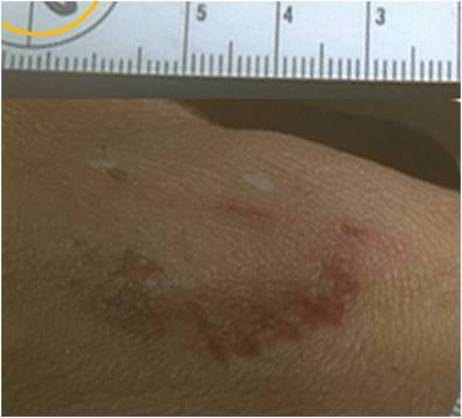
bitephoto2

Evidence considered a human bitemark in 1997.

In 2009 both dentists recanted in affidavits and later court testimony. They credited the use of “new” advances in digital imaging allowed them to see a single autopsy photo of the victim’s hand without its original off-angle camera distortion. That was made possible by this forensic dentistry digital imaging manual.

Back to today’s “High Court” opinion.

“The plain meaning of the amendment to section 1473 makes clear that an expert opinion given at trial can later be deemed ―false evidence‖ under two circumstances: (1) if the expert repudiates his or own opinion given at trial; or (2) if the opinion given at trial is undermined by subsequent ―scientific research or technological advances.‖ (§ 1473, subd. (e)(1).) We conclude that, under this amendment to section 1473, petitioner has met his burden to show that Dr. Sperber‘s trial testimony constituted false evidence under either circumstance.”

Soon we will hear what the San Bernardino DA has to say about this. According to a news report in 2012, San Bernardino has never had an exoneration on the books under Ramos’ tenure.  The same article has the DA office offering considerable resistance to the term “exoneration.” DAs in this situation have 60 days to ponder whether to re-charge after a vacated conviction. This potentially would be Richards’ 5th trial for murder.

Here is the broader context of Richards’ now improved chances for  freedom.  DA Ramos has also gone on the record saying he considers frivolous appeals are “clogging up” California’s Criminal Justice system.

The future trial?

Any new filing of murder charges by the DA against Richards will bring a litany of CSI high value evidence against Richard being guilty. In fact it forms a road to his actual innocence.

A jury would have to consider some of the following:

  1. DNA from an unknown make have been recovered from the murder weapon.
  2. DNA from an unknown male was found under the victim’s fingernails.
  3. The Supreme Court court noted that the bite mark evidence had been “clearly repudiated” and that “new technological advances undermined” the bite mark evidence presented at trial.
  4. The crime scene evidence collection was either faulty or not complete which resulted in significant evidence being abandoned or lost at the outset of the San Bernardino Sheriff’s investigation.
  5. The Supreme Court also said that the defense had presented strong evidence opposing Richard’s guilt at his 4th trial where he was convicted EXCEPT for the bitemark evidence.

The total court’s opinion of In re William Richards is here.  Its 45 pages.

Richards’ litigation team is the California Innocence Project at California Western School of Law. This is its Twitter feed.

 
@CA_Innocence


Posted in Uncategorized | Tagged , , , , , , | Leave a comment

Washington DC crime lab continues to coverup its law enforcement bungles

Forensics In Wash DC: Former crime lab managers punished for telling the unpopular truth to their bosses.

csidds's avatarFORENSICS and LAW in FOCUS @ CSIDDS | News and Trends

Backstory before the story about guns walking away from the DC crime lab.

After a sweetheart period with its “independence” from LEO management via its multi-million dollar facility up grade and hiring forensic scientist Max Houck to run it, the D.C. DFS bloom has gone off the rose.

Dr. Houck got himself resigned/fired from DFS by a consortium of LEO, DA and mayoral accusations of his Forensic Biology Unit’s mixture DNA statistical choices regardless of similar DNA protocol disagreements existing within the general crime lab industry.

Some in the national DNA hierarchy called it a “sentinel event” in the history of crime lab decision making. With scant exaggeration,  it struck to the heart of what some of us considered a significant foothold for “reform in forensic science.” One called it a “setback for forensic science.”

DNA gurus Inman, Rudin and Siegel demanded answers here.   The DNA trio issued a…

View original post 948 more words

Posted in Uncategorized | Leave a comment

Washington DC crime lab continues to coverup its law enforcement bungles


Backstory before the story about guns walking away from the DC crime lab.

After a sweetheart period with its “independence” from LEO management via its multi-million dollar facility up grade and hiring forensic scientist Max Houck to run it, the D.C. DFS bloom has gone off the rose.

Dr. Houck got himself resigned/fired from DFS by a consortium of LEO, DA and mayoral accusations of his Forensic Biology Unit’s mixture DNA statistical choices regardless of similar DNA protocol disagreements existing within the general crime lab industry.

Some in the national DNA hierarchy called it a “sentinel event” in the history of crime lab decision making. With scant exaggeration,  it struck to the heart of what some of us considered a significant foothold for “reform in forensic science.” One called it a “setback for forensic science.”

DNA gurus Inman, Rudin and Siegel demanded answers here.   The DNA trio issued a statement ….

“However, we assert that if all U.S. forensic DNA laboratories were held to the same standard to which the D.C. DFS lab was held, few would be left standing.”

A D.C. DA lead review of 182 cases after Houck’s firing seems to not have made the news since Houck’s 2015 firing.

His replacement after an interim director is  now the fully appointed director, Jenifer Smith who spearheaded…………

“As a DFS consultant, Smith provided her expertise in assessing the findings of the Independent Audit of the Forensic Biology Unit, and provided her recommendation for trainings on DNA mixture interpretation.”

In other words, after participating (after the fact but surely profiting from it) in the contested by a few (see below) audit by ANSI-ANAB’s (which itself has no lack of detractors) cadre of ex-crime lab directors, she eventually got Houck’s job.

The DFS advisory board had another member, the same Jay Seigel noted above, who put out a telling letter to the California Asso of Criminalists  (pg 11) in 2015 about his take on Houck’s ouster the consortium. Bold is added as emphasis.

“Recent events that culminated in the hasty and in my view, unwarranted dismissal of the administration of the DFS has given me great pause and concern. The only scientific issue of merit in this process was the protocols used in the interpretation of the level of significance of contributors to certain DNA mixtures. It is well known in the forensic science community that there are no standards for the statistical interpretation of such mixtures. The DNA unit of the DC Forensic Science Laboratory was using methods that represent a consensus among many forensic science DNA units nationwide. The Panel convened by the DC US Attorney’s Office had a different opinion about the protocols that should be used by the laboratory. On the advice of the Scientific Advisory Board, the Laboratory changed some of its protocols and SOPs in the area of DNA mixtures. The laboratory made several requests of the USAO to furnish it with the protocols that are used by the Panel, but was unsuccessful. At its meeting of April 24, 2015, the Scientific Advisory Board began to prepare a letter to the USAO to furnish this and other information so that the Board could examine the merits of the Panel report. During the latter stages of that same meeting, the report of the independent 3rd party, who was commissioned by your office to evaluate the DNA unit, issued its report to you. The Board received the report late in the afternoon of its meeting on April 24. The Board had no chance to evaluate this report during that meeting or in the few days after. Just a few days later, without consultation with the Board, you proceeded to fire the senior administration of the Laboratory. The Board had no chance to review the issues raised in the two reports and to perform its statutory duties of advising the Laboratory, your office and the City Council. The District of Columbia has an extensive and well-deserved reputation for political interference in a wide variety of its activities and processes. I hoped that this would not be the case with the DFS when I joined the Board. My hopes were misplaced. The actions you and I believe the USAO have taken in this matter were clearly not based on scientific considerations since the Scientific Advisory Board had no chance to provide advice BEFORE you took such drastic actions. I cannot continue to serve as a member of the Science Advisory Board and I hereby resign, effective immediately. Sincerely, Jay A. Siegel PhD”

Others who formed the admin of DFS during Houck’s tenure have also been lopped off the tree.

Its general counsel, Christine Funk  got terminated. Her history as criminal defense counsel surely opposed the new director’s 23 years of FBI employment. The chief scientist and the DNA Unit manager were also fired.

“Funk’s boss (Max Houck) says her experience makes her invaluable to DFS . . . She understands the law, she understands the labs, and she’s about as knowledgeable about science as any attorney I’ve met,” Director Max M. Houck said. “As an independent agency, she provides us with the insights and feedback we need to stay objective. She’s our keystone.”  From a 2013  DFS post before the coup occurred.

In their salad days in early 2015, Funk and Houck were international speakers in the UK on the subject of independent managed crime science facilities and, among other subjects, certain “reform” procedures considered progressive. This four day meeting’s theme was “A Paradigm Shift for Forensic Science,” It did not include having ex-officio firings occur as described supra.

Guns on the Run?

The latest victim to this resurgence of  political, police and prosecutorial control just filed a wrongful termination suit revealed in his claim a pattern of fire-arm mismanagement tangentally akin to the “Fast and Furious” BATF debacle  from 2011 (which is still simmering). The press brought us from that debacle the F&F term “gun walking” used by law enforcement.

Apparently guns have been “walking” out of the ballistics and firearm unit of the DC lab for years. The guy who made the finding is the one filing the lawsuit. He was their gun manager.

Of course a real question is “who is stealing the weapons out of the evidence room and selling them on the streets of Washington D.C.?

Here’s a snippet from the lawsuit:

“Jason Kolowski claims the department fired him one week after he disclosed an “anomaly” in the its database that showed weapons with the same serial number entered twice for unrelated cases.”

Read The tale of lost guns in the D.C. Evidence locker. 


Posted in AAFS, US Crime labs | Tagged , , | 1 Comment