


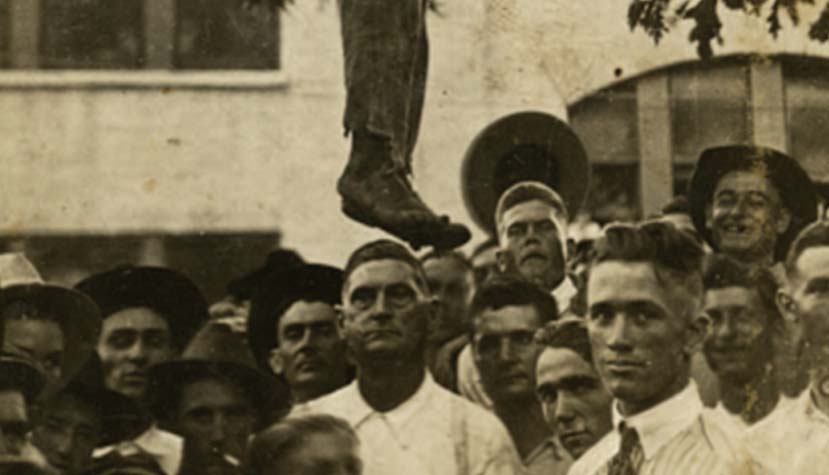
Someone in Donald Trumps’ circle of law enforcement influence said that “quelling” of public demonstrations is in order. Here’s a bit of some background about such self-righteous use of power and influence to subordinate other citizens’ rights.
In his 1867 annual message to Congress, President Andrew Johnson declared that black Americans had “less capacity for government than any other race of people,” that they would “relapse into barbarism” if left to their own devices, and that giving them the vote would result in “a tyranny such as this continent has never yet witnessed.” Instead of facilitating black land ownership, President Johnson (a Unionist former slaveholder from Tennessee) advocated a new practice that soon replaced slavery as a primary source of Southern agricultural labor: sharecropping.
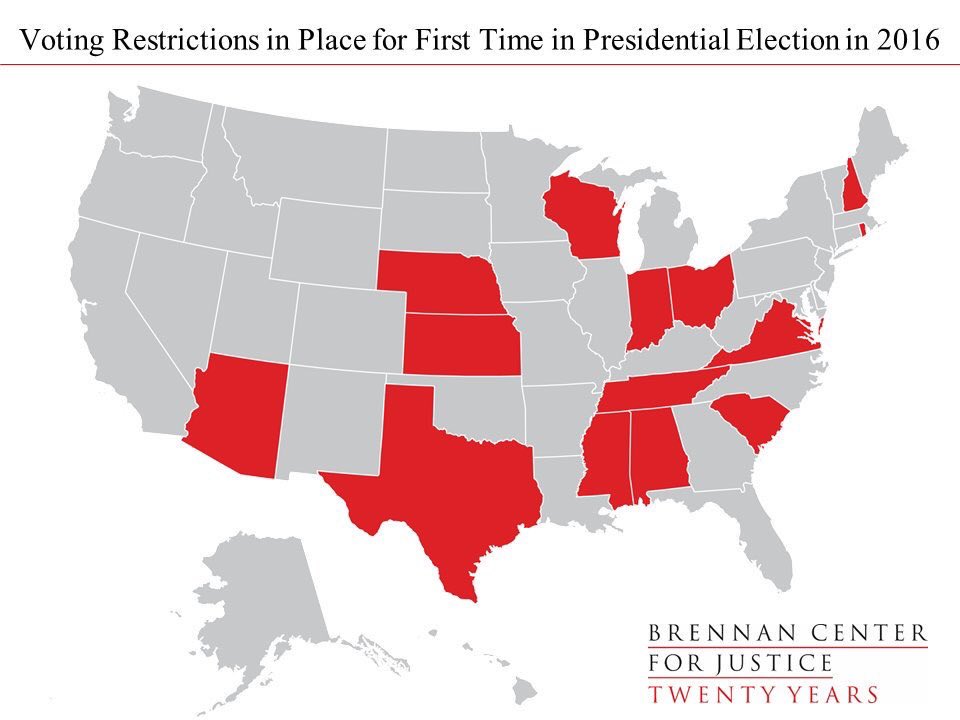
and voter suppression:
Short Report from the Equal Justice Initiative on lynching as another means of suppression.
State by state and each county history of lynchings from 1877 to 1950.
Thanks to the EJI Institute
Donate to the EJI

Another case right out of “Making A Murderer.” Most of this courtroom questioning is textbook but the reporter did a good job of presenting the gist of what the policeman’s (Slager) defense lawyer is trying to do.
This is a reverse of the norm because the police are on trial for an unjustified shooting. But the thread is common with all other criminal defense tactics. It’s partially a battle of ‘missed’ evidence (as in no fingerprint testing of the officer’s Taser) collection and a strong supposition that the police first statements about shooting someone (Scott) running away was not all too correct.
From Charlotte NC.
Related from Sept 28, 2016 ; Nov 8, 2016.
A telling look at how medical expert wits years of declaring homicidal child deaths were talking through their hats about their ‘confidence.’ This Swedish collation of studies actually collected circumstances within existing pop studies containing adequate sampling of case data. Ultimately, their conclusion is: no adequate supporting data to affirm the pro-SBS claims. Only 2 studies could be considered determinative. Two. The dogmatist experts working for the London Met Police might need to take a look at this.
To examine the quality of evidence supporting the triad alone as a hallmark of child abuse, a team in Sweden narrowed 3700 abusive head trauma studies down to 1000 that were relevant to the triad of symptoms. Of these, 30 met their strict criteria, such as having a large enough sample size, and not including cases that involved extra injuries in addition to the triad. Of these, they deemed only two studies, both conducted in France and published in 2010, to contain plausible evidence that the triad of symptoms, in the absence of other injuries, point to child abuse. However, the team decided that these didn’t show sufficient support for the triad alone as definitive evidence of abuse, in part due to a lack of detail about the adults’ confessions of shaking.

It’s a reject in Lorain County Ohio.
It’s a go in NM for its new state crime lab.
Ex-cop crime scene analyst gets grilled over ballistics evidence in Scott police shooting.

Bitemarks lead the list: NIST speaker reveals…….
[excerpt:]
“They can’t even agree on their own science,” Epstein said. “But bite marks as evidence continue to be used.”
“It’s a pitiful stat,” Epstein remarked.

The instantaneous rejection of the latest Executive Office’s forensic review revealed much about the deniers.
This discussion on likelihoods of forensic success or failure from the ‘Einstein Institute’ leads me to wonder if the US cohorts of lawyers: DAs, Attorney Generals, and other US pattern-lookers really have the discerning, training and motivation for any of this.
It really about preventing “subjective” testimony leading to wrongful convictions. Be forewarned, as a good portion of this has a distinctive European origin. Note: Here is AFSP (UK) and ENFSI (EuroZone).
One proposal is to assign probabilities based on experience and subjective judgement. This appears to be advocated in the Association of Forensic Science Providers (AFSP) 2009 standards, and the 2015 European Network of Forensic Science Institutes (ENFSI) guideline on evaluative reporting. But the warrant for such subjective judgements has been questioned. The 1993 US Supreme Court Daubert ruling and the 2016 report by the President’s Council of Advisors on Science and Technology (PCAST) argue strongly that subjective judgment is not enough, that empirical validation is needed.
If a forensic likelihood ratio is to be based on subjective judgement, it has been proposed that the judgement be empirically calibrated.
Read the discussion’s reasoning and alternative choices. I’m sure it will be thought-provoking.
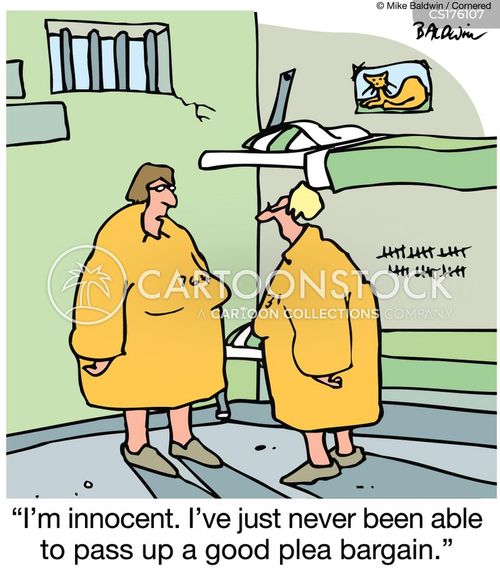
An important look at the 95% of criminal cases that end up plea bargains.
By Garrett and Mitchell
However, a CSI effect could be more consequential if it affects how criminal lawyers assess forensic evidence when they negotiate pleas or decide what evidence to present at trial. In this Essay, we begin to examine how criminal defense lawyers and prosecutors assess forensics, and we compare their views to those expressed by lay jurors. Part I of this Essay surveys the literature on the role that evidence plays in the plea bargaining process. In Part II, we present the results of two surveys that examine views on fingerprint and DNA evidence. We conclude in Part III by outlining how these surveys can provide a useful starting place for further research and policy.


