
Update: No official info on the 2d autopsy. There is a social media screenshot from Today (Saturday) at the end of this post that is unverified.
What is known
Demartravion “Trey” Reed, a 21-year-old Black student at Delta State University in Cleveland, Mississippi, was found dead on campus on September 15, 2025. His body was found hanging from a tree near the pickleball courts at the university. Local authorities — including the Bolivar County Coroner’s Office and the Mississippi State Medical Examiner’s Office — conducted an autopsy and preliminary investigations. The findings from that autopsy concluded that: Cause of death was hanging. Manner of death was determined to be suicide. The coroner reported no signs of assault or injuries consistent with being physically attacked. Specifically, no broken bones, no lacerations or contusions indicating violence.
What is disputed – what the family and public are questioning
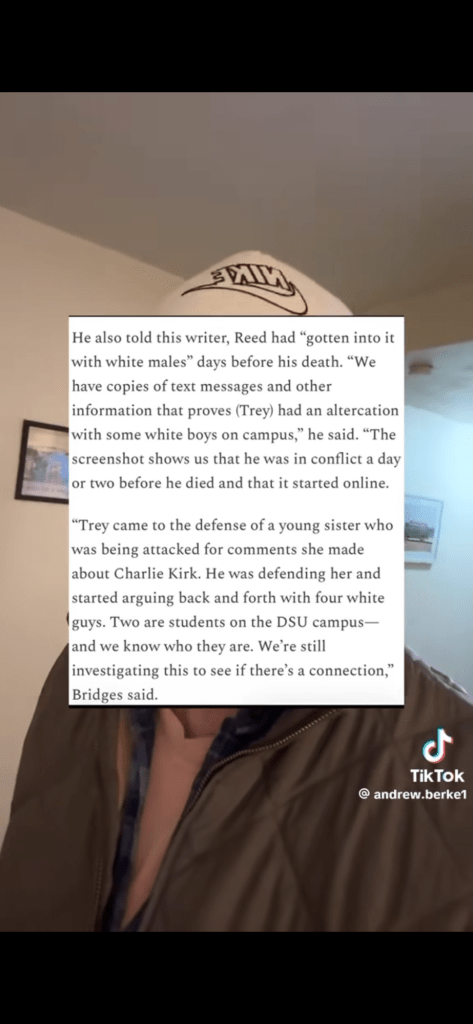
The family of Trey Reed, represented by civil rights attorney Ben Crump, has raised concerns about how transparent the investigation has been whether all relevant evidence has been disclosed, whether there were inconsistencies in what authorities said, and whether the findings fully address everyone’s questions. A major point of contention is the social media claims that Trey had broken bones, which would seem inconsistent with suicide by hanging. These claims have been firmly denied by the coroner’s office, which says no broken bones were found. There is also concern over conflicting accounts of where his body was found (some reports said a tree on campus, some that he was in a dorm room) which feeds into suspicions among the public. The family has requested (and is getting) an independent private autopsy, funded by Colin Kaepernick’s Know Your Rights Camp Autopsy Initiative, to get a second, impartial look.
What is still unknown – what needs verification
Toxicology results are pending. These could shed further light on whether any substances were involved. Whether there is video surveillance or other physical evidence that might clarify what happened leading up to his death. Some reports say there is video; however, details are not yet fully released. Whether “suicide” as the manner of death will stand after the independent autopsy or if new evidence might contradict or modify it. Whether there is any evidence of foul play beyond what has been ruled out so far.
Up to today:
Independent autopsy results — As of the latest reports, the independent autopsy has not yet been completed (or publicized). The family and their legal team will likely wait for those results to see if they align with or challenge the state’s findings. Though the autopsy is complete, full lab results (e.g. toxicology) can take weeks. Those results may shed light on substances or other biological factors. Authorities say video(s) exist and are under review. But which footage, how much, and whether it will be shared publicly (or with the family) is not yet clear. Any conflicting forensic evidence. If the independent autopsy or further lab work reveals inconsistencies (e.g. injuries missed, ligand analysis, etc.), that could change the interpretation. Full clarity on chain-of-communication. The mismatch between early statements to the family (e.g., “died in dorm”) vs later public accounts raises concerns about how information was handled. Resolving that will be part of what the family is seeking. Federal involvement outcome. Whether the FBI or Department of Justice will formally open a civil rights or criminal probe is still to be determined.


 FORENSICS and LAW in FOCUS @ CSIDDS | News and Trends